
The Living Clean Guide to Non-Toxic Camping Gear (Part 8) – Comfort & Hygiene


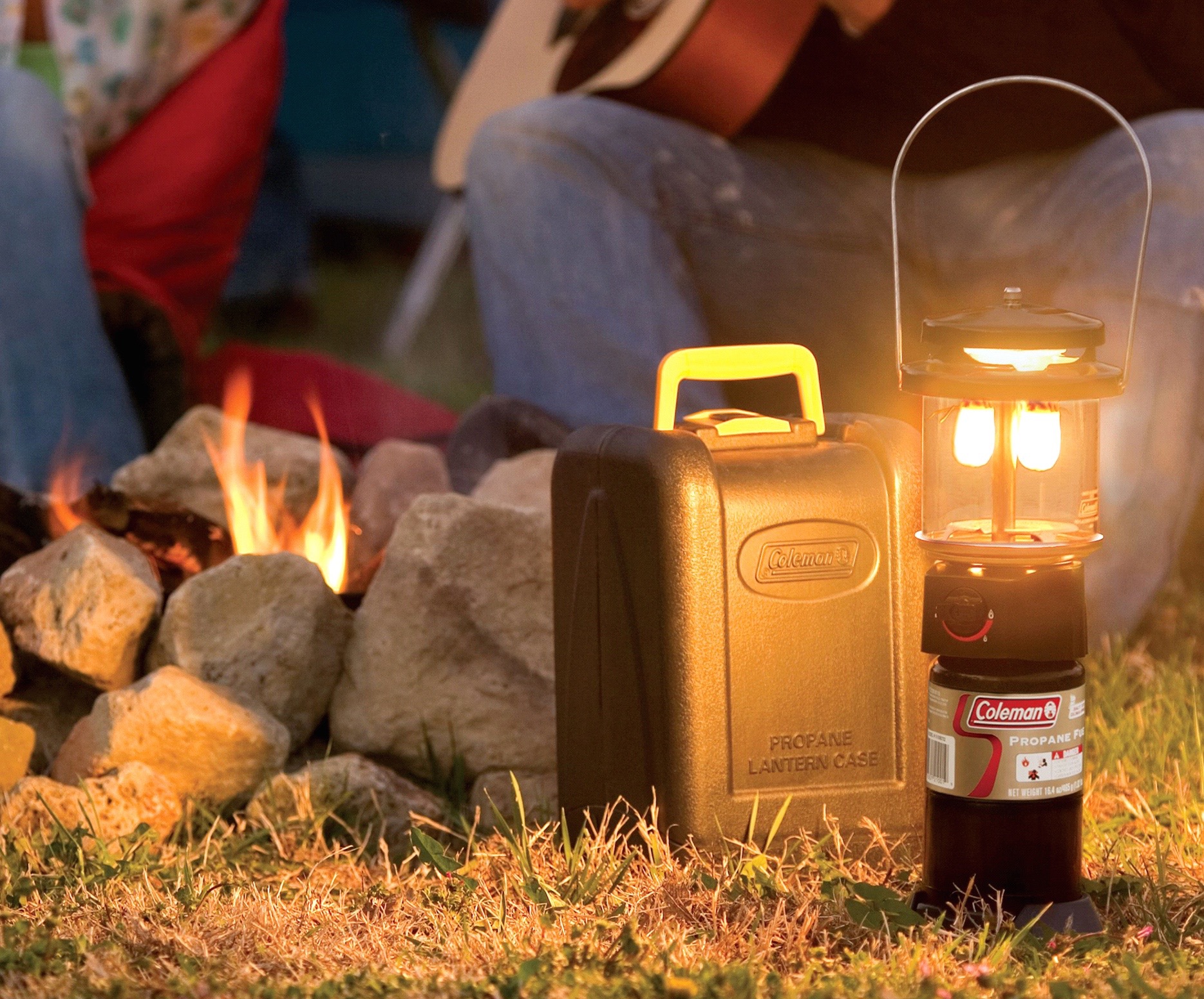
A Coleman Propane Lantern.
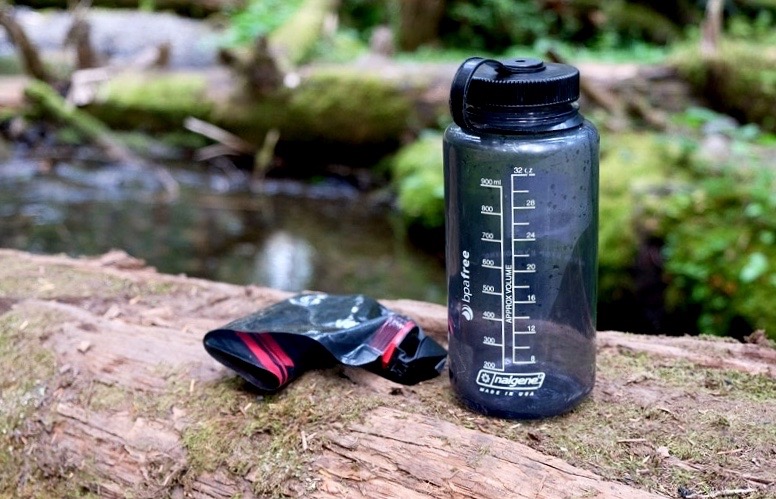
A Nalgene water bottle.
WATER
Although it would be nice to think that a Berkey or other high-end water filter could make any water encountered on travels to be drinkable, I feel pretty strongly that that is not the case.
The problem is that although these expensive and bulky water filters do remove many kinds of toxicity, they are totally useless when it comes to removing some of the most common and dangerous water toxins – cyanobacteria toxins (including BMAA, a toxin now believed to be one of the factors causing people to get ALS) and radioactivity.
If water is contaminated with those toxins, then probably distilling the water will address the problem. Reverse osmosis conceivably might address the problem (but then again, it might not).
Unfortunately, other water filters are not capable of effectively addressing issues with those kinds of toxicity, to my understanding.
If people are settled in one place, then I think it is plausible that they will be able to start to get a sense of whether particular kinds of filtration can make their tap water safe to drink. In some cases, that may mean that a Berkey or similar water filter (which removes most particles other than radiation or cyanotoxins) will be very helpful.
I’ve consumed almost exclusively filtered tap water myself in recent years when living in certain locations (including Taos, Desert Hot Springs and my current northwestern Illinois residence). So it is not that I am against filtered water per se.
For those on the road though, the water supply is a much more unknown quantity. Moreover, since the purity of the water coming out of the tap can change on a moment-to-moment basis, even if the water seems like it is okay to drink on one occasion does not mean that it is always going to be that way.
Especially for people who are on a mold avoidance sabbatical, avoiding especially problematic water toxins seems of particular importance. Consuming cyanotoxins can create symptoms that are similar to those caused by environmental mold exposures, thus creating confusion and preventing the goal of getting as clear as possible from toxic exposures during the sabbatical from being accomplished.
Unless it seems clear that the local water is quite good, I suggest the routine use of certain brands of bottled spring water for drinking while on the road.
Based on my experiences and on what I have heard from other people, Arrowhead, Crystal Geyser and Mountain Valley Spring Water tend to be fairly consistently good quality.
I also feel pretty good about the purity of some the imported water brands, including Fiji, San Pellegrino, Perrier, Voss, Evian and Gerolsteiner.
Although distilled water is not ideal due to its lack of beneficial minerals, it also could be used on occasion.
Typically when I was camping, I would buy a supply of gallon-sized bottles of water to be used at the campsite, as well as a supply of 16-ounce bottles to be used when hiking or traveling.
Considering that a high-end filter like the Berkey may not be very useful for the sabbatical, it seems to me hard to justify bringing one along since it would up a lot of space.
Conceivably a case could be made for bringing along a small Brita (which does a good job with chlorine and lead) or similar filter, and I did carry a small one with me on most of my travels. Except for when I was in a place where the water was obviously good except for the chlorine contamination (notably Desert Hot Springs), I almost never used it though.
What I do think that a Brita could be useful for is to produce filtered water for particularly effective decontamination showers. Although the Brita will not remove cyanotoxins from problem water, it should remove most of the cyanobacteria spores and spore fragments (and thereby reduce the extent to which the water will cross-contaminate hair and skin when used for washing).
Being able to shower in water that is free of chlorine and lead may be helpful as well.
The Berkey admittedly would produce even better filtered water for showering, but it processes water so slowly that I don’t see it as being worth dragging along just for this task.
Note, by the way, that Erik Johnson has stated that boiling water contaminated with certain particularly problematic cyanobacteria prior to using it for showering has been much more effective for him than filtering it. Although I have not experimented with that approach myself (since I generally just do not stay in places where the water seems that bad to me), that could be another thing to try.
Although I always had a collapsible five-gallon water container with me, I rarely used it since I almost always was staying at developed campgrounds with tap water available near my campsite.
I do think a water container like that will be a good thing to have on hand in case I decide to go totally off-grid for a night or two though.
Although I mostly used disposable bottles of water when hiking, I did always have a few Nalgene water bottles on hand back at the campsite. The 32-ounce size were especially useful for making iced tea or lemonade, for instance.
Water Filters:
Brita 6-Cup Water Pitcher. $22.
Water Storage:
Coleman Water Carrier, 5 Gallon. $15.
Reliance Products Desert Patrol 3 Gallon Rigid Water Container. $21.
Ozark Trail Stainless Steel Water Bottle, 64 oz. $15.
Information:
EPA – Cyanotoxins in Drinking Water
Enviro News – Radioactive Water
Mold Avoiders – Drinking Water Poll
Backpacking Mastery – Best Water Bottles
COMFORT
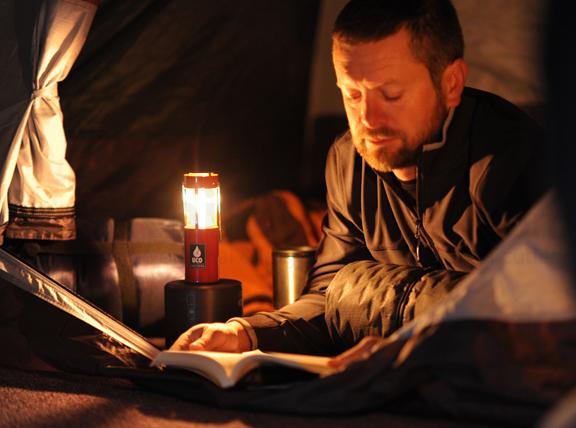
The UCO Original Candle Lantern.
LIGHTING
A positive development in camping over the last ten years is that a really large selection of lanterns, headlamps and flashlights has become available at much better prices than in the past. The downside, however, is that almost all of this lighting is LED – that is, the kind of lighting that Dave Asprey has referred to as “junk lighting.”
My feeling about this is that camping generally involves being exposed to large amounts of natural and “nutritious” light as a result of being outdoors almost all the time, and also involves being much more free of the general toxic stresses that people encounter in their everyday lives. Perhaps as a result, using a little LED light at night when camping never has seemed like it was causing the same sorts of negative issues that constant exposures to LED’s while living indoors sometimes have for me.

The Black Diamond Voyager Lantern.
I do think it’s better to use these LED lights on their low setting the vast majority of the time, however. In addition, purchasing products that have a red light setting (which is supposed to be better for health) could be considered.
I used to have a couple of Black Diamond Apollo Lanterns, which I used mostly in my tent and sometimes outdoors at the campsite. They worked well enough that I’ll probably buy a new Black Diamond lantern (hopefully at a good sale price) to take with me on my upcoming trips.
I recently purchased a pair of L.L. Bean Collapsible Mini Camp Lites, which fold up tiny and seem like they will work well in my tent. I may try out some of the larger L.L. Bean lanterns too, since many of them seem to get pretty good reviews.
The outdoors can become extremely dark when camping, and so consistently using a headlamp or flashlight when walking around can be very important to avoid injury.
While expensive flashlights and headlamps often have very high-powered lights, I almost never found it necessary or even desirable to use lights like that when camping. To the contrary, I virtually always used low beams so as not to annoy other people (and because bright light was not very pleasant for me either).
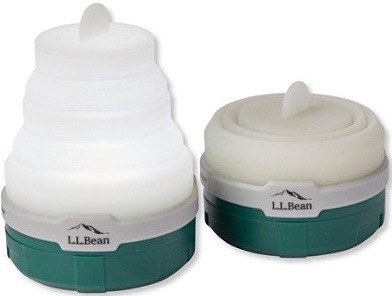
L.L. Bean Collapsible Lights.
Although the idea of using red lights is a little interesting, in general I have never found it necessary to pay extra for a flashlight or a headlamp in order to get extra features. The less expensive models have always seemed to work out fine for me.
In general, headlamps have seemed to make more sense to me when camping since they have allowed me to carry things while lighting the way, but I always have had a few flashlights (usually the small plastic ones from Walmart costing a dollar or two) on hand as well.
Walmart has plenty of other inexpensive battery-operated lanterns, flashlights and headlamps available as well. I likely will stop by there and then stock up on all the lighting options (as well as things such as batteries and propane tanks) that I need.
Especially for those who are spending time in the desert, trying out some solar lighting alternatives even if they seem a little costly on the front end probably will ultimately make financial sense.
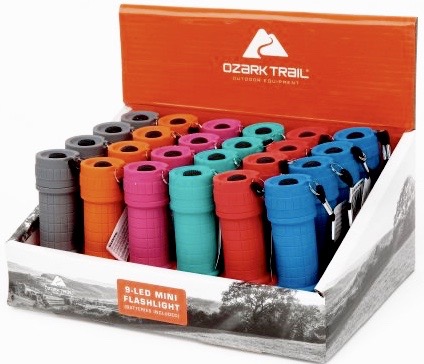
Walmart Flashlights.
I am especially interested in the Suaoki Collapsible Clover Style Lantern because I think it might work well as a ceiling light in a tent.
While it’s probably unrealistic to not use battery-operated LED lights at all when camping, using natural light as much as possible is much nicer from a variety of perspectives.
When I was camping frequently, I had a Coleman Dual Premium Fuel Lantern that I used with white gas outdoors at night.
(The other fuel option for the lamp was gasoline, which I never tried since I try to avoid contact with gasoline as much as I can. The Coleman Premium Blend Fuel never felt like a big problem to me though.)
I liked the quality of the light that the dual-fuel lamp produced, but carrying around the lantern as well as a big can of lamp fuel took up quite a bit of space in the car.
This time around, I am interested in trying a lantern that runs on the little propane tanks that I almost always have around anyway to run my stove.
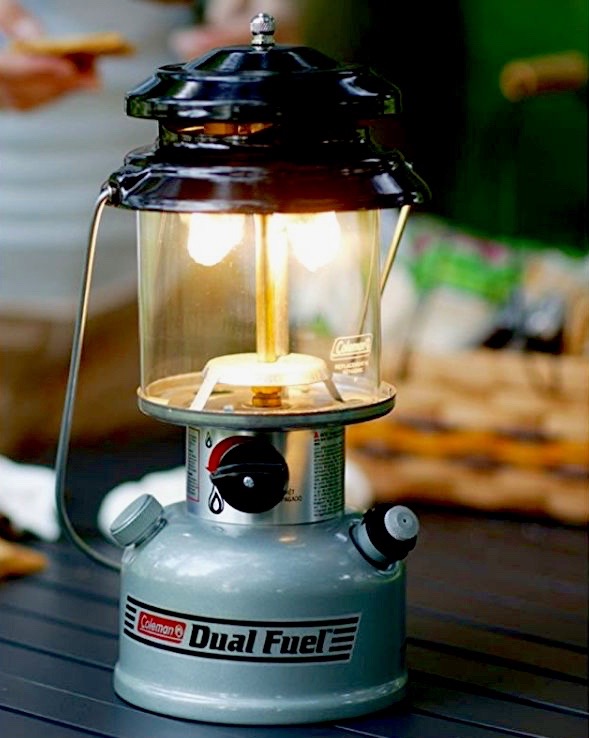
The Coleman Dual Fuel Lantern.
Although the Coleman Deluxe PerfectFlow Lantern does not have an electric starter, and although the lack of a case means that I would need to find a way to protect the glass chimney from breakage, I like the fact that this lamp seems like it could be carried around for occasional use without requiring much storage space.
The Coleman NorthStar Lantern also seems very nice, though it would take up quite a bit more room in the car. It includes an Instant Start feature, though that is not very important to me since I always make a point to carry around a good supply of long lighters with me to use when needed.
For any of these Coleman lanterns, having a good supply of the mantles on hand would be important since, in my experience, these can be fussy and sometimes can get burned up really quickly.
One type of lighting device that I somehow missed out on entirely during all my camping adventures was the UCO Camping Lantern. Although candlelight is always a nice thing, the idea that the candle could be held in a lantern that would allow it to be used outdoors and in my tent or RV never even occurred to me.
As it turns out, these little lanterns have been around since the 1970’s and get great reviews.
Especially when the three-candle unit (dubbed the Candlelier) is used, people swear that it can put off enough heat to make a significant difference with regard to the temperature of a small indoor space. That sounds almost too good to be true, and so I would like to try it (maybe in a controlled experiment) to see if it helps.
Although I would be extremely hesitant to use any kind of non-battery source of energy in the back of my van, these little candle lanterns seem like they very well may be reasonably safe.
The natural beeswax candles – while a little pricey at about $4 per candle – also make me feel enthusiastic about the product from an apparent toxicity standpoint.
Battery-Operated Lanterns:
*L.L. Bean Collapsible Mini Camp Lites. $20.
Black Diamond Moji Lantern. $20.
L.L. Bean 45-Day Camp Lantern. $30.
Black Diamond Voyager Lantern. $40.
*Black Diamond Apollo Lantern. $50.
More L.L. Bean Lanterns. $20-35.
Headlamps:
Black Diamond Spot Headlamp. $40.
Flashlights:
*Walmart Ozark Trail 9 LED Mini Flashlight. $2.
Solar Lights:
Ivation Solar USB LED Collapsible Camping Lantern. $13.
Bigfoot Outdoor Products Compact Solar Camping Lantern with USB. $14.
Biolite SunLight Solar Powered Lantern. $25.
Suaoki LED Solar Powered & USB Camping Lantern. $26.
*Suaoki Collapsible Clover Style LED Solar & USB Camping Tent Lantern. $30.
Candle Lanterns:
*UCO Candle Lantern 3.5″ Beeswax Candles. $12+.
UCO Micro Candle Lantern. $17.
*UCO Original Collapsible Candle Lantern. $20.
UCO Candelier Deluxe Candle Lantern. $40.
UCO Candle Lantern Accessory – Cocoon Neoprene Cover. $13+.
Butane Lamps:
Snow Peak Mini Flame Lantern. $35.
Propane Lamps:
Coleman Deluxe PerfectFlow Lantern. $45.
Coleman Northstar Propane Lantern with Case. $80.
White Gas Lamps:
*Coleman Premium Dual Fuel Lantern with Carry Case. $100.
Fuel-Operated Lamp Accessories:
*Coleman Standard String Tie #21 Mantles. $11.
*Coleman Premium Blend Fuel, 32 Ounces. $11.
Propane Cylinders.
Additional Information:
Outdoor Gear Lab – Camp Lanterns

The Four Dog Ultralite Tent Stove.
HEATING
Winter can be a challenge for many individuals pursuing mold avoidance. In addition to cold weather being a problem, in many locations – especially cities – the outside air often can be much worse in terms of toxicity during the several months surrounding the winter solstice than it is the rest of the year.
Having a good strategy in place to deal with the colder months of the year therefore is very important.
A first question for those with some flexibility with regard to locations is to decide where to spend the winter.
While most people automatically head for warmer climates, in many cases the air quality is actually better during the winter months in colder areas outside cities where the ground gets frozen up. Considering the alternative of spending winter in a colder location rather than automatically ruling it out therefore could be worthwhile in some circumstances.

A Lasko ceramic heater.
Of course, living in a cold climate in an RV or other vehicle in winter is extremely difficult, and doing so in a tent is basically impossible.
The strategy of finding an indoor environment that (even if it is not pristine) is good enough not to cause major long-term health effects as a place to spend the winter could be considered, however. In many cases people who have been camping for an extended period of time enjoy being indoors for a time during the winter months, even if they are not sure that this is something that they are going to be doing permanently.
While there are some locations (such as Florida and southern California) where the weather is warm enough to tent camp all winter, in most cases those places are not very good with regard to toxicity issues.
More typical even in the Southwest U.S. is for locations to be reasonably warm during the day (such as in the 50’s or low 60’s) and then to drop into the 20’s or low 30’s at night. While it is possible to live without any heat at all in such circumstances when tent camping or RV camping, that is not necessarily very comfortable.
Even for people who often camp off-grid, having electricity during the winter months can be desirable since being able to run a small electric heater or heating pad can be extremely helpful in remaining comfortable during winter months.
Since an increasing number of RV parks seem to be having problems with their sewer systems, thinking about alternative ways to get electricity – such as by camping outside a private house – might be worthwhile.
Living in an insulated RV or van in temperatures that periodically drop into the 20’s or 30’s actually is pretty comfortable and straightforward, provided that electricity is available to power an electric heater as well as a vent fan.
Figuring out a way to get access to electricity at least for those months therefore may be considered a priority, since the options when electricity are not available are considerably more difficult.
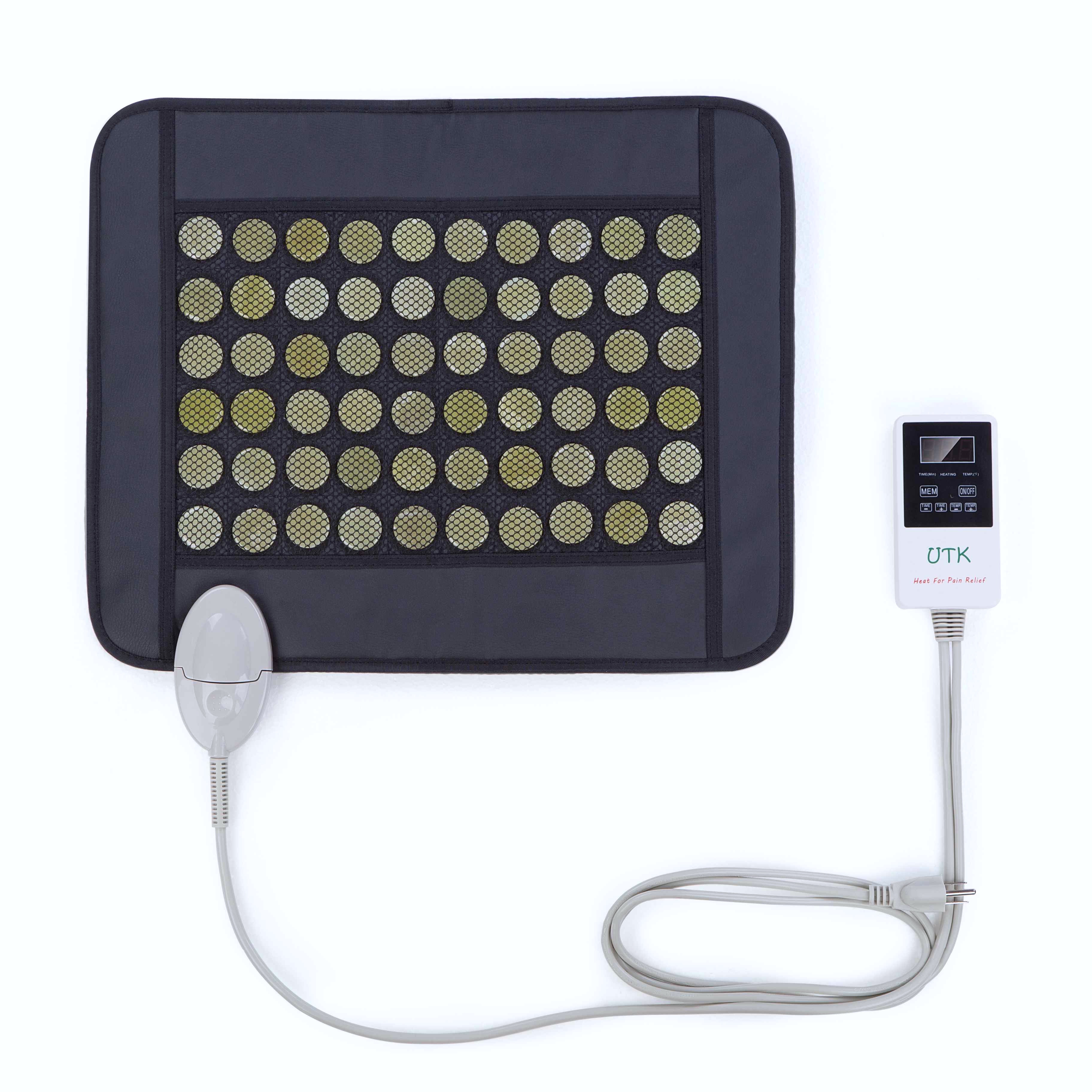
The UTK Far Infrared Natural Jade Heating Pad.
Even large solar systems appropriate for use with RV’s do not produce enough energy to power even a small general heater for even a short period of time per day, for instance.
At most, they may have the potential of powering a small heating pad – usually for just a few hours per night or possibly in some cases the full night.
Generators (which have become significantly quieter as well as a little smaller and a little cheaper over the past decade) do have some potential of providing reliable energy to power a heater, heating pad or other electric appliances to those living off-grid.
Still, a Honda generator capable of powering a small heater and running a few other items would be consist of a cube of about 12″ x 12″ x 10″, weighing 51 pounds and costing more than $1100. In addition, because the generator runs on gasoline, it could not be used or likely even stored inside a vehicle that was also being driven or used as living space by individuals with chronic illness, and would instead need to be handled separately (for instance, attached in a metal box to the outside of the vehicle or hauled in a gear trailer).
Another possibility is to use a portable propane heater. For instance, my Casita Travel Trailer came with an installed RV furnace, which ran off the gas from my 5-gallon propane tanks.
(I used the propane heater on a few occasions but I never liked it very much since it felt very toxic to me. I was always unclear whether that was due to cross-contamination of the machinery with problematic toxins or to the propane itself – probably the former since my propane stove did not feel bad to me. In any case, eventually I gave up on the furnace in favor of using electric heaters.)
A possible alternative to a propane RV heater is a portable propane heater, such as is offered by Mr. Heater with its Buddy line or by Camco in its Olympian Wave products. In theory, these products are supposed to be usable indoors, and I do somewhat agree with the logic that if they were killing people when used according to the instructions, the company would have been sued out of existence.
Still, I would feel very uncomfortable using one of these products in a motorhome or van, because of the possibility that if a fire did occur, the gas tank could catch fire.
In addition, although the Mr. Heater materials specifically say that their product can be used in a tent, it would seem to me that this would have to be a very large tent in order to get the proper clearances around the unit, and that in any case I would be concerned about the possibility of the unit catching on fire.
The idea of using the heaters in a standalone trailer for discrete periods of time with the tow vehicle parked somewhat away is slightly less concerning but still worrisome in terms of fire danger.
In addition, the heaters state that they are to be used only when the user is awake, which limits their usefulness to some extent.
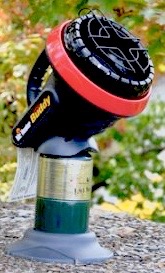
The Mr. Heater Little Buddy.
I also wonder whether they would feel toxic to me even with proper ventilation, and some of them (especially the Mr. Heater products) seem to be expensive to run and to break quickly.
A particularly relevant downside of these propane heaters (at least according to Bob Wells of Cheap RV Living) is that they apparently release large amounts of moisture that can lead to mold problems. Maintaining plenty of ventilation is said to be helpful for this, but whether even that would entirely address the problem, I’m not sure.
The Mr. Heater products are restricted from being sold in Massachusetts and Canada. I’m not sure about the Camco Olympian Wave products, though I am not seeing any mention of such restrictions on their website or on the Amazon listing.
If I ever were to resort to using one of these products, it likely would be just in a standalone trailer. I would read the instructions very carefully; would be careful to have at least as much clearance around the unit as they say are necessary; would have a lot of ventilation going (considerably more than they recommend); would have a battery-powered carbon monoxide detector set up; would be awake and alert while it was running; and would have a fire extinguisher that I knew how to use at the ready in case a fire occurred. I still wouldn’t feel great about using it, but probably with all those precautions, the risks to my life would be fairly low.
Another alternative that has sometimes been discussed is using a one-burner stove inside the vehicle as a heat source. To my understanding, none of the portable propane camping stoves are approved for internal use (which perplexes me a bit since I am not sure how the propane RV stove that I used multiple times a day in my Casita was any more safe).
A stove that appears to be approved for indoor commercial use (including in Canada) is the Iwatani butane stove, which is used in very large numbers of homes and restaurants in Japan (as well as smaller numbers of them here in the U.S.). While it is not approved for heating use, I feel confident that in a small trailer, using it for cooking even with plenty of ventilation would raise the temperature of the area substantially, and that using it to heat water for a hot water bottle or a hot drink would be additionally helpful.
I’m still nervous about the idea of using butane at all though, even with this stove which is supposed to have effective safeguards to protect against butane explosions that are sometimes reported with other butane stoves. I also would be concerned about the open flame in this stove (even though I cooked multiple times a day with an open flame with the gas stove in my Casita), and of course would want to take all the same precautions that I would with the heaters if I ever were to use one of these stoves indoors.
Erik Johnson, who lives in a cold climate, says that purchasing a small wood stove (designed for tent use) for his own RV has solved a wide variety of wintertime problems for him.
Most importantly, the stove is used as heat, and he says that it produces such a large amount of heat that he can keep the doors and windows of his RV entirely open with the vent fan running even when it is very cold outdoors. He also uses the stove for cooking and boiling water, and says that the heat from the stove also is helpful in allowing his laundry to dry very fast.
In addition, the wood stoves does not have the downside of propane heat in terms of producing excess moisture that can lead to mold issues. Erik also is able to avoid spending any money on fuel costs in winter, since he obtains and cuts up his own wood.
Of course, a wood stove presents the same kinds of fire hazards and carbon monoxide hazards that the propane heaters do. If I ever were going to consider one, I would want to be very well-versed in my understanding of how to work the stove and how to prevent problems, since the idea makes me pretty nervous.
One more idea that I have come across is using candles as a way to create enough heat to make a difference in an RV when it is cold outside. Even a few small candles seem to be sufficient to prompt some people – such as many of those commenting on the UCO candle lantern – to insist that the amount of heat generated has been helpful to them.
In any event, the idea of having candlelight while camping is a rather pleasant one, and while I generally avoid bringing anything glass along with me when camping, perhaps in this case it would be worth it.
Of course, candles can easily lead to fires as well, and so I would want to make sure that I had thought this through carefully to make sure that the risks had been addressed before using something like this indoors.
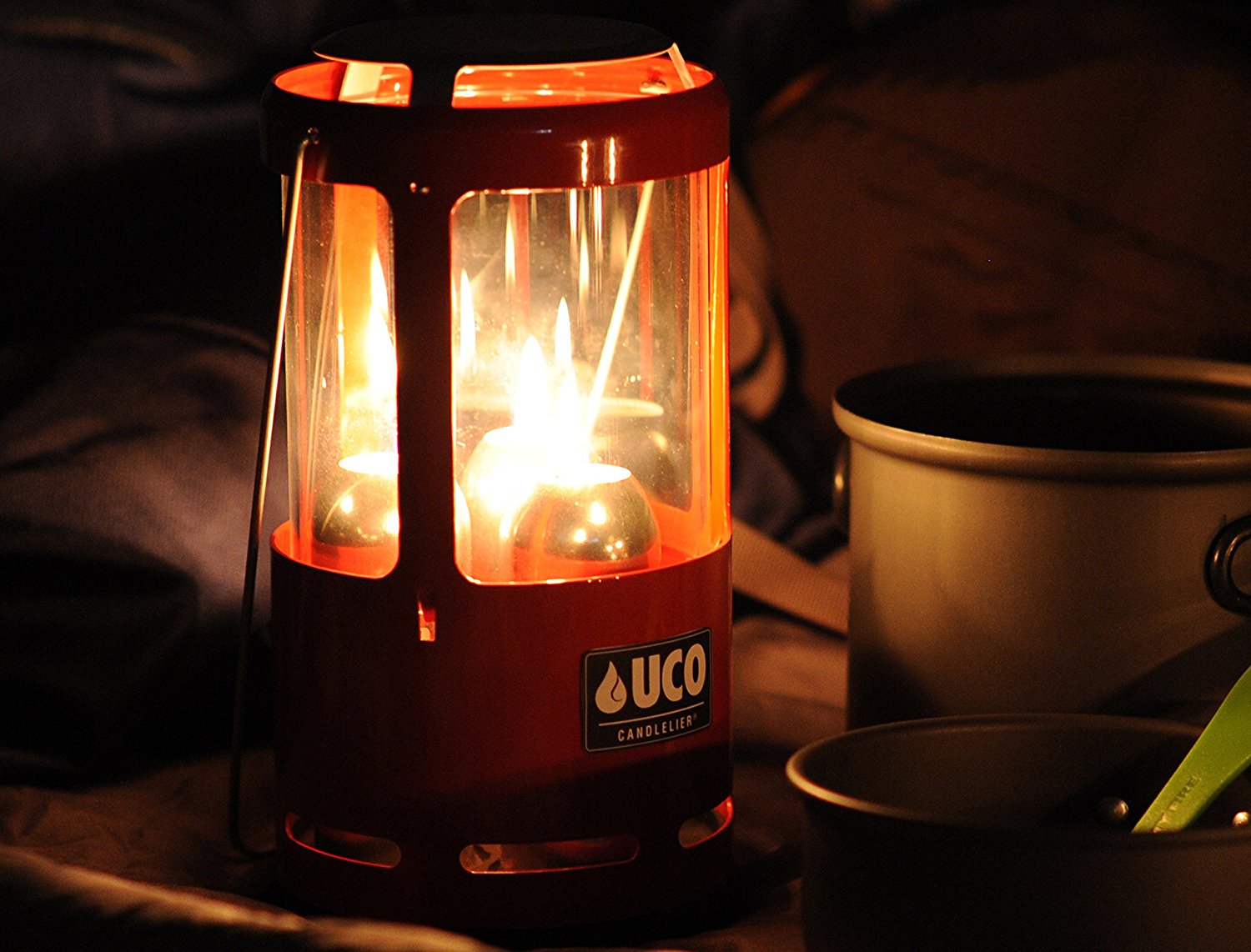
The UCO Candlelier Deluxe Candle Lantern.
Although I do not have plans to move to a cold climate in an RV any time in the near future, I have been vaguely thinking about the idea of taking a summertime trip to Alaska. A good bit of that trip would be through areas of Canada (including the Yukon) that are pretty chilly at night even in summer. Although I hope that I might be able to find electric hookups for at least part of the trip, I wouldn’t want to count on that.
Because this would mostly be a driving trip, and because the mountainous areas like this are usually much warmer during the day, I mostly would be thinking about how to stay warm at night.
I’m still pondering whether I should add permanent insulation such as styrofoam to my van for the trip. If I don’t, I might hang up some wool blankets on the walls or experiment with other temporary forms of insulation (including maybe multiple layers of non-toxic rugs on the floor) to help insulate it a bit.
I will need to be prepared with a warm enough sleeping bag and sleeping clothes, and a wool blanket to use as an extra covering over the sleeping bag. Using a reflective sleeping pad on my cot also may help to make things feel warmer.
If possible, I would like to have enough battery power so that if I wanted to run my infrared heating pad for a little while when I first went to bed or if I woke up in the middle of the night feeling cold, I could do that.
I also would plan to heat up some water for a hot water bottle and also to make hot tea for my thermos right before going to bed, since that is another thing that can be very helpful if I wake up feeling cold.
My feeling is that if I do all of these things, I should be able to survive reasonably comfortably even if the temperature gets down into the 20’s at night, without feeling a great deprivation from not having a general heating source.
Likely if I were planning to spend an indefinite amount of time in colder temperatures, or if the temperatures were colder, I would be really motivated to come up with a more effective solution, though.
Following are a few brief thoughts in terms of particular heating oriented products.
When I was living in my RV, I mostly spent winters plugged into electric power. At first I used electric heaters, but eventually I switched to mostly using a electric blanket unless it was really cold, because that allowed me to stay warm even when I had the windows open and the vent fan running to get lots of air circulation.
I decided to try the electric blanket after another mold avoider said that she had strongly benefited from using one while sleeping in her truck all winter. Although EMF’s were theoretically a concern with the electric blanket, I thought that it felt okay to me.
(The electric blanket was a Sunbeam, but I am not sure which version it was. The Sunbeam model mentioned here – as well as th spa wrap – was suggested by Corinne from the blog “My Chemical Free House.”)
Eventually I decided to try a small infrared heating pad – one with flat jade stones, made by a company called UTK. I have really enjoyed this for extra warmth at home as well as on my travels, in bed and also sometimes during the day. A few other mold avoiders have provided me with positive reports about this particular infrared heating pad as well.
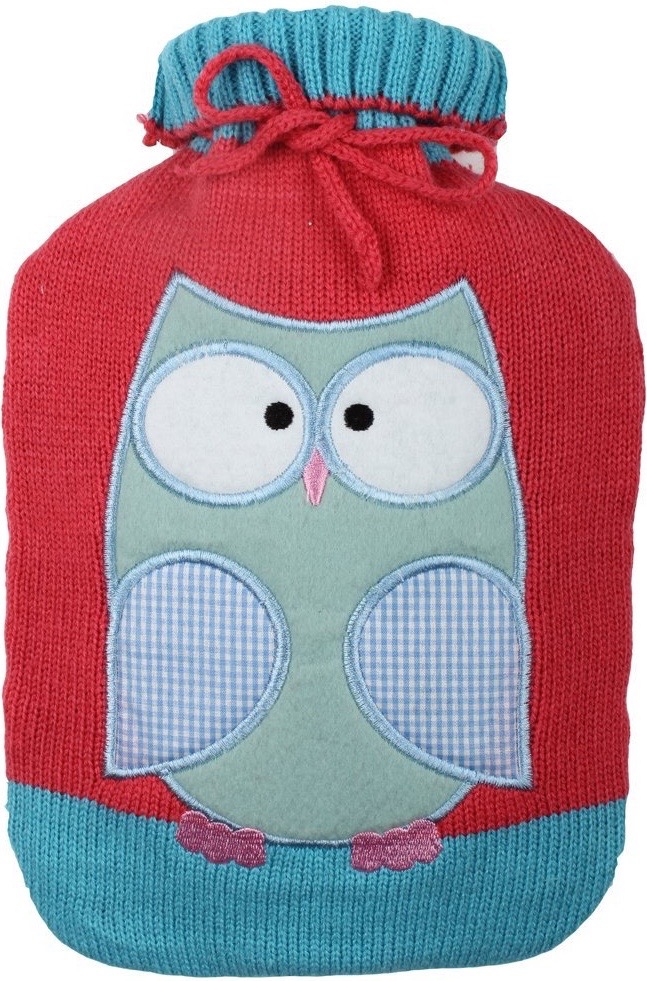
A hot water bottle cover.
The other options on the list below – the heated blanket and the spa wrap – were suggested by Corinne of “My Chemical-Free House” in a blog article on camping gear. I cannot remember what brand of electric blanket I had (I bought it at Walmart) and have not tried the spa wrap mentioned here.
If electricity is going to be available for part or all of a trip when the weather will be cool, then I would consider bringing along an electric space heater. Although I have tried quite a few of these over the years, a really small ceramic one – such as a Lasko – seems most appropriate for a van or camping trip.
Erik Johnson has said that buying a Four Dog Wood Stove for his camper and cargo trailer is one of the best mold avoidance decisions he has made. I have not used one of these wood stoves myself, but for those planning to live full-time in an RV or other vehicle in a cold climate, it sounds like it could be an option worth looking into.
Although I know people who have used portable propane heaters (such as the Mr. Heater Buddy) or portable propane stoves in their RV’s or vehicles, I have yet to do that. I did use the propane stove and propane heater that came standard with my Casita though, and am not sure that those were any less dangerous.
One thing that I have heard is that running while the three Mr. Heater devices (the Little Buddy, the Buddy and the Big Buddy) are not very expensive, they do run through those little Coleman-type propane tanks very quickly. There does seem to be a way to adapt the two larger units – but not the Little Buddy – to run from a larger and much less expensive propane tank, but this apparently needs to be done in a certain way in order to keep the jets from being clogged up. Spending some time researching the topic before moving forward seems like it would be a very good idea with this.
A hot water bottle as well as a thermos of hot tea or other hot drink can make a big difference when sleeping in a cold tent or vehicle. Supposedly the Fashy hot water bottles (which are made in Germany) hold heat longer and so I am inclined to spend the extra money on one of those rather than opting for a less effective product.
Infrared Mats:
*UTK Far Infrared Natural Jade Heating Pad. $119.
*Charmed Far Infrared Mini Mat. $319.
Electric Blankets & Wraps:
Mind & Body Electric Spa Wrap. $40.
*Sunbeam Quilted Fleece Heated Blanket. $40+.
Heaters:
*Lasko Ceramic Heater with Adjustable Thermostat. $32.
Mr. Heater Little Buddy Portable Radiant Heater. $65.
Mr. Heater Buddy Indoor-Safe Portable Radiant Heater. $144.
Camco Olympian Wave 3 LP Portable Gas Catalytic Heater. $375.
Four Dog Ultralite Tent Stove. $825-970.
Hot Water Bottles:
Attmu Classic Rubber Hot Water Bottle with Knit Cover. $11.
Home Top Large 2 Liter Hot Water Bottle Knit Cover. $13.
Fashy Transparent Classic Hot Water Bottle. $19.
Additional Information:
Cheap RV Living – Heater Review
Prius Stealth Camper Adventures – 5000 BTU Candle Camper Heater
COOLING
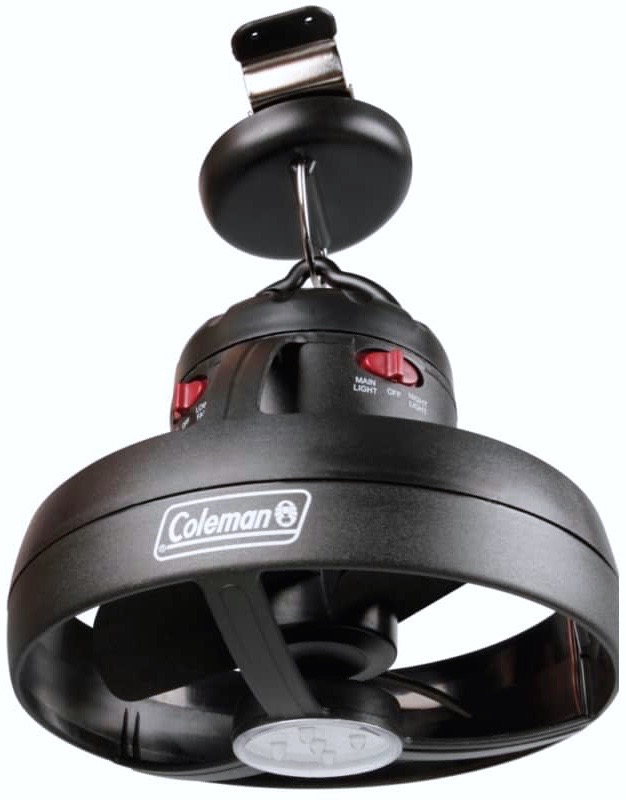
The Coleman Tent Fan.
I got a fair amount of use when I was camping out of my Coleman Ceiling Fan, which ran on D batteries. Sometimes just a little bit of breeze from a fan at night can make a big difference, and so I would definitely bring along one of these if I were going to be tent camping very much in hot weather.
Portable Fans:
O2Cool 5″ Clip Fan (AA Batteries). $15.
O2Cool 5″ Portable Fan (D Batteries). $19.
O2Cool 10″ Portable Camping Fan with Lights (Electric or D Batteries). $55.
O2Cool 10″ Battery Operated Fan (Electric or D Batteries or Rechargeable Battery). $60.
Ceiling Fans:
Image Portable LED Camping Lantern with Ceiling Fan. $21.
Coleman Ceiling Fan with Light (D Batteries). $25.
Air Conditioners:
Black & Decker Portable Air Conditioner, 8000 BTU’s. $297.
Additional Information:
Cheap RV Living – Staying Cool
Thrifty Outdoors Man – Tent Fans
The Cooler Reviews – Camping Tent Fans
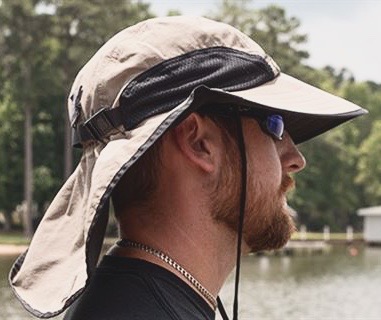
The Sunday Afternoons Adventure Hat.
LIGHT & SOUND PROTECTION
Being outside in the sunlight all the time while camping – especially in the desert – can take a toll on the eyes. I suggest that sunglasses be worn most of the time, for the sake of comfort and since all that UV exposure appears to have the potential of increasing the likelihood of the development of cataracts. For those who wear glasses, getting a pair of prescription sunglasses or Transitions glasses can be really helpful in encouraging regular sunglasses use.
I never felt it necessary or desirable to wear sunscreen even when in the brightest desert. However, I did almost always wear a big (and some would say stupid-looking) hat with a wide brim almost continuously when camping, and I would suggest that others consider doing this as well.
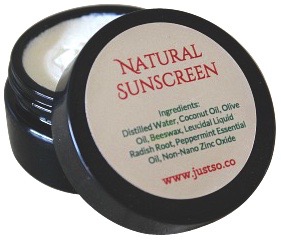
Just So Natural Sunscreen.
An ideal hat, in my opinion, provides protection from the sun while allowing some peripheral vision, also provides some protection from light rain, attaches under the chin so that it doesn’t blow away, is ventilated so that it doesn’t make my head feel hot and sweaty, is so comfortable that I forget that I have it on, packs down small for travel, can be washed occasionally without being damaged, and looks halfway decent even after I have been wearing it a lot.
Quite a few hats from Sunday Afternoons meet all these criteria, for instance. I have several hats of theirs, all of which have held up for years and worked well for me.
If I were going to use a sunscreen, the one that I likely would choose would be the Just So Natural Sunscreen made by Andrea Fabry, a mold avoider who has shared information about toxic mold in her book Is Your House Making You Sick? and on a website called momsAWARE. The sunscreen contains non-nanoparticle zinc plus a variety of other high-quality natural ingredients. I’ve done really well with many of her other products and so feel confident that this one would be good for me too.
A number of mold avoiders have brought up Badger Unscented as being helpful for them (and in some cases for their children), and so that is the mainstream option that I likely would choose.
I used to use a sunscreen by Burt’s Bees that was somewhat similar to the one currently being sold by them for babies, and so that is another one that I might try.

A sleep mask from The Sleepy Cottage.
Although it is possible that the environment on a camping trip will allow for blissfully undisturbed sleep, there’s no guarantee that is how things are going to turn out. Human-generated light and sounds – as well as animal sounds – have the potential of interfering with sleep, especially for those who have sensory sensitivities as a result of their chronic illness.
Bringing along a good set of earplugs and a good sleep mask therefore may be a good idea. (Note that I have not tried the Happy Camper mask shown here and so am not necessarily recommending it, even though I think it’s kind of cute.)
Sun Hats:
*Sunday Afternoons Sport Hat. $36.
*Sunday Afternoons Adventure Hat. $39.
*Sunday Afternoons Women’s Lotus Hat. $39.
Sunscreen:
Just So Natural Sunscreen. $15.
Burt’s Bees Baby Nourishing Mineral Sunscreen. $15.
Badget Unscented Sunscreen. $18.
Additional Sun Protection:
Sunglasses.
Sounder Sleep:
The Sleepy Cottage Happy Camper Sleep Mask. $16-18.
Sleep Mask.
Ear Plugs.
Additional Reading:
EWG – Nanoparticles in Sunscreens
No Sleepless Nights – Best Sleep Masks
The Wirecutter – Best Earplugs
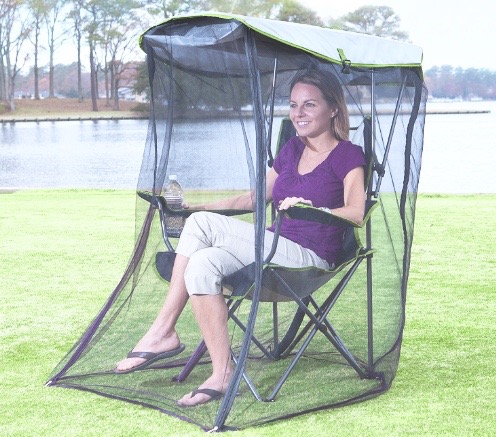
The Kelsyus Original Canopy Chair with Bug Guard.
INSECT PROTECTION
Dealing with insects in a way that does not involve exposures to unacceptable levels of toxicity – especially while camping and hiking – has the potential of being a problem for mold avoiders. Insects (especially ticks but also mosquitos and other bugs) have the potential of spreading infections that may be especially problematic for individuals with this sort of illness, but attempting to fend off the bugs through the use of toxic chemicals is not an acceptable solution either.
To some extent, addressing the problem by just avoiding the bugs as best as possible is worth considering. If mosquitos are particularly problematic in an area, then perhaps trying a different location would be a good idea. With regard to ticks, hiking on well-worn trails rather than through tall grass – and also setting up the tent away from areas with high grass- may be a good idea.
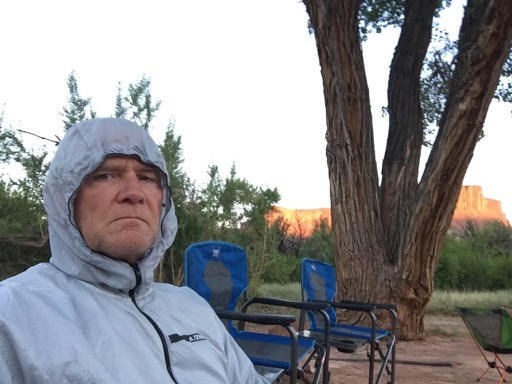
Using a jacket as a mosquito protectant. Photo Credit: Kurt Papke/Backpack Gear Test.
The use of clothing as a defense against insects is probably used too infrequently as a defense against insects by most people in the U.S. (including by me). Probably we would be better off if we considered that a first line of defense as people do in many other countries where insects are a particular problem, since using clothing as protection is both more effective and less toxic than the chemical solutions that dominate the thinking here.
For ticks, for instance, wearing long pants tucked into moderately heavy socks seems to be accepted as a good strategy for tick avoidance.
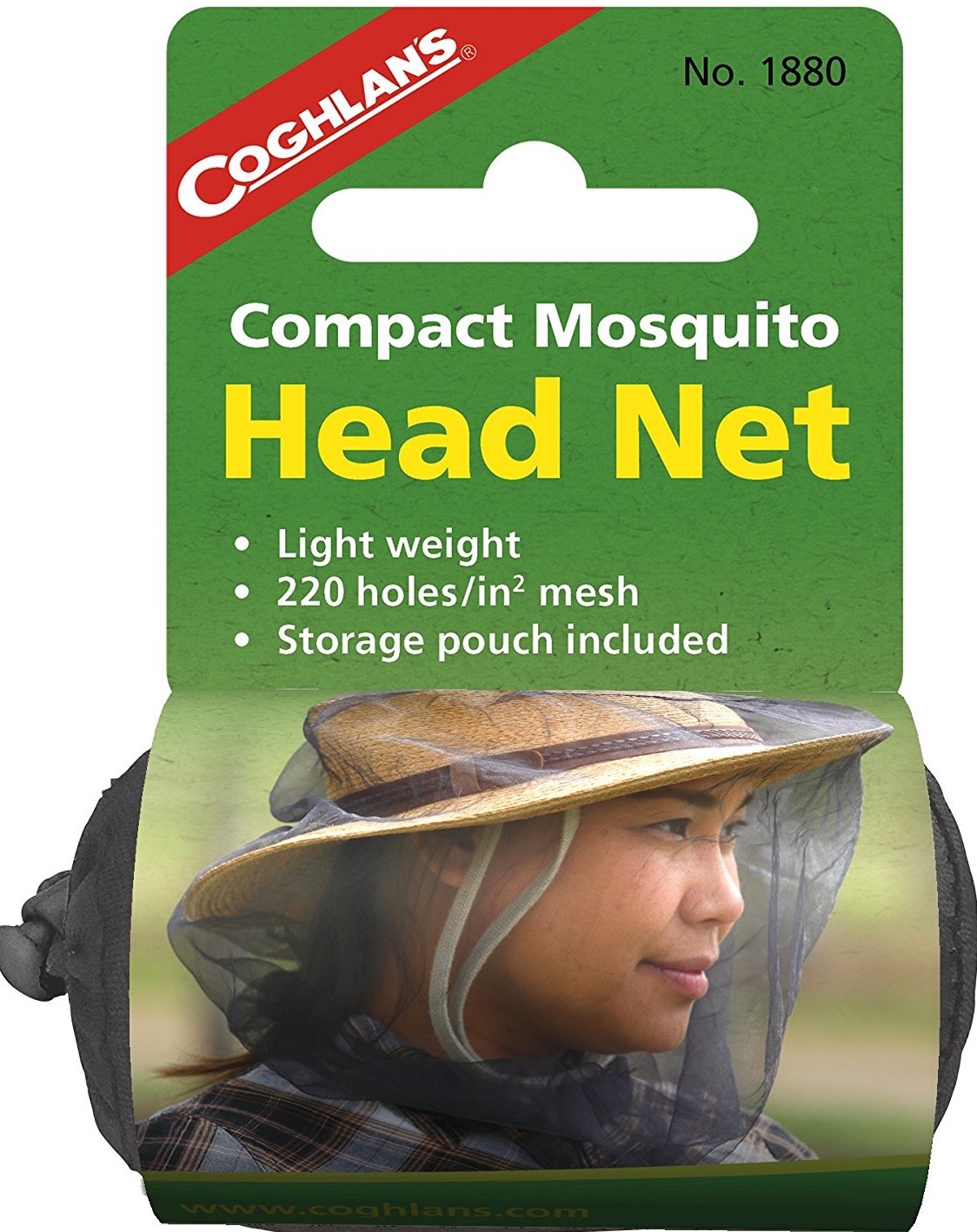
For mosquitos or other flying bugs, plenty of clothing specifically designed to protect against bugs is available, but normal clothing also can serve as protection with, at most, only a small additional investment. For instance, a mosquito or no-see-um head net can pair with any hat with a brim to provide protection against non-obtrusive protection of the face and neck. A light and breathable hooded windbreaker with elastic on the wrists also can be helpful.
A new trend is for clothing (including some head netting) to be treated with permethrin, which is an artificial chemical that kills various insects. This does not wash out of clothing, although dry cleaning may remove it. Probably this chemical is at least less harmful than DEET or other insect repellants, though I haven’t felt comfortable enough with it to try it myself.
For those who are able to tolerate permetrin and feel comfortable with it, L.L. Bean offers a whole line of clothing that is pre-treated with it under the designation of “No Fly Zone.” Other clothing may be self-treated using liquid spray products, although I would suggest starting out with just one item since this chemical remains in clothing for many washes.
Quite a few commercial products now contain a substance called “Oil of Lemon Eucalyptus,” which is approved by the FDA as an alternative to DEET for repelling ticks, mosquitos and certain other insects. Note, however, that this substance is not just lemon eucalyptus essential oil. Rather, it is a highly processed chemical derived from lemon eucalyptus oil that contains a very high amount of a chemical called p-menthane 3,8-diol (PMD) – something that is present only in very small amounts in the ordinary lemon eucalyptus essential oil.
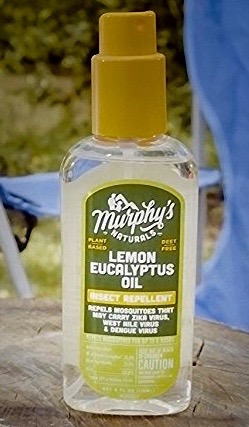
Murphy’s Naturals Lemon Eucalyptus Oil Insect Repellent.
The highly processed form of Oil of Lemon Eucalyptus may or may not be tolerated by those with chemical sensitivities, but regardless, figuring out whether it is included in products is important since it bears little resemblance to regular lemon eucalyptus essential oil. It took me some time digging to come up with a list of products that apparently contain at least some of the processed Oil of Lemon Eucalyptus, since it can be hard to differentiate them in the descriptions from ones with lemon eucalyptus oil.
A problem I have with the labeling of almost all of these Oil of Lemon Eucalyptus products is that while the smaller brands are not necessarily making me feel confident that they actually are using sufficient enough amounts of the processed Oil of Lemon Eucalyptus with a high PMD content to be effective, the larger brands are not necessarily revealing all of their non-active ingredients. I may purchase some of the Murphy’s Naturals version to try out though, since it is the only one that I have found that lists the active ingredient on the label in the standard way and that also lists its non-active ingredients (just ethanol and water).
Regular lemon eucalyptus essential oil does not seem to be an especially good bug repellant compared to many other essential oils. While essential oils have not been proven to the satisfaction of the FDA to repel insects, I do think that they have some efficacy for that and are worth using. Reapplying them frequently may be necessary in many cases to keep them working, however.
A variety of pre-combined essential oil blends with ingredients said to repel insects are available from various companies. For individual essential oils, I really like Florihana, which is a French company selling very high-quality oils (through its own website and through Healthy Traditions) for more reasonable prices than are offered by the multi-level marketing essential oil companies based in the U.S.
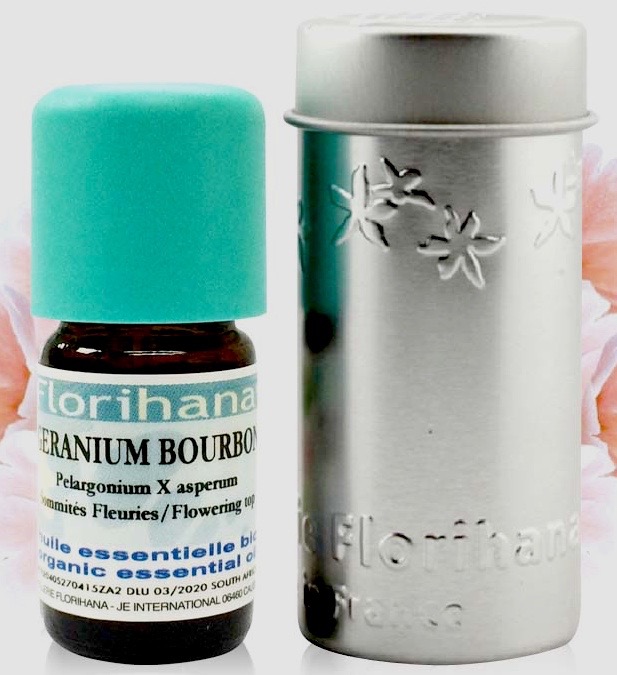
Florihana Geranium Bourbon Essential Oil.
Since essential oils in their pure form can be pretty caustic, diluting them before use is usually a good idea. This can be done either by mixing them with oils or creams, or by first cutting them with a little alcohol (such as vodka) and then mixing them with water, apple cider vinegar or other liquid to create a spray.
For bug protection at the campsite, I think that having a screen room (as discussed in the section toward the top of this article) may be really helpful. I really would like to find an inexpensive shelter that can be used immediately by people who are sensitive to fire retardants and other kinds of toxicity, since this seems to have the potential of improving people’s camping experiences significantly.
As previously discussed, draping mosquito netting over shade shelters (or attaching it to the inside of these shelters) may be a good option since mosquito netting is not required to contain fire retardants. (Although some of it might contain permethrin, my understanding is that it should be labeled if that is the case.)
A few personal bug shelters (including canopy chairs with bug screens) also are available, for both seated and reclining positions. I would like to hear some reports on those.

The Mekkapro Ultra Large Mosquito Net (used with a hammock).
For those sleeping in vans or cars with conventional roll-down windows, Bob Wells of Cheap RV Living offers some guidelines on how to easily use mosquito netting or no-see-um netting to create window screens.
Finally, occasionally campgrounds have major ant problems, and some of those desert ants can have stinging bites that remain painful for an extended period of time. Sprinkling some diatomaceous earth on the ground (including in the ant holes when they are found) always has resolved this problem quickly and effectively enough that carrying around some DE with me, just in case I run into ants, always has seemed well worthwhile.
Clothing:
Sea to Summit Bug Jacket and Mitts. $30.
Bug Baffler Insect Protective Mesh Shirt. $38.
Headpieces & Hats:
Coghlan’s No-See-Um Head Net. $5.
Coghlan’s Mosquito Head Net. $6-10.
Vilhahn Mosquitos Head Face Neck Insect Repellent Netting. $8.
Camo Coll Outdoor Anti-Mosquito Mask Hat. $13.
UShake Mosquito Head Net Hat. $17.
Insect Netting:
Equinox No-See-Um Netting. $12.
The Friendly Swede Camping Mosquito Net. $15.
Expedition Mosquito Net, 84″ x 39″ x 66″. $17.
Coghlan’s Rectangular Mosquito Net. $19+.
Coghlan’s Hikers Mosquito Net. $32.
Mekkapro Ultra Large Mosquito Net. $30.
Timbuktoo Luxury Mosquito Net. $44.
Permethrin Products:
L.L. Bean No Fly Zone Clothing. $15+.
Sawyer Products Premium Permethrin Clothing Insect Repellent. $18.
$averPak Single JT Eaton Permethrin Clothing and Gear Spray. $19.
Repellents – Oil of Lemon Eucalyptus:
Cutter Oil of Lemon Eucalyptus Insect Repellant. $4.
Repel Oil of Lemon Eucalyptus Insect Repellant. $5.
Coleman Botanicals Insect Repellent with Oil of Lemon Eucalyptus. $8.
Whole Clarity Insect Repellant with Oil of Lemon Eucalyptus. $10.
Murphy’s Naturals Lemon Eucalyptus Oil Insect Repellent. $12.
Look Out Bugs Natural Bug Repellent with Oil of Lemon Eucalyptus. $25.
Mosi-Guard Insect Repellent Stick. $29.
Essential Oils:
Eden’s Garden Pest Defy Essential Oil. $6+.
Plant Therapy Nature Shield Essential Oil Blend. $9+.
Plant Therapy Kid Safe Shield Me. $10+.
Healing Solutions Pest Shield Essential Oil Blend. $10.
*doTerra Terrashield Essential Oil Blend. $14.
*Florihana Essential Oils – Healthy Traditions.
Essential Oils – Sprays & Creams:
*Sallye Ander No Bite Me Cream. $12.
doTerra Terrashield Spray. $26.
Chair Shelters:
Kelsyus Original Canopy Chair with Bug Guard (Discounted). $70.
Kelsyus Original Canopy Chair with Bug Guard. $80.
Under the Weather Mesh Pod. $80.
Bed Shelters:
Shadezilla Instant Pop-Up Mosquito/Bug Tent. $50.
SansBug 1-Person Pop-Up Mosquito Net with Tarp Floor. $50.
Kamp-Rite Insect Protection System. $85.
Ant Protection:
Harris Diatomaceous Earth. $13.
Additional Information:
Backpack Gear Test – Adidas Terrex Agravic Alpha Hooded Shield Windbreaker
Cheap RV Living – Mosquito Screens and Permetrin Treatment
Rodale’s Organic Life – Mosquitos & Lemon Eucalyptus
Hebe Botanics – Oil of Lemon Eucalyptus vs. Lemon Eucalyptus Essential Oil
Mercola – Repelling Mosquitoes
Wellness Mama – Homemade Bug Spray
Tisserand Institute – Tick Repellant
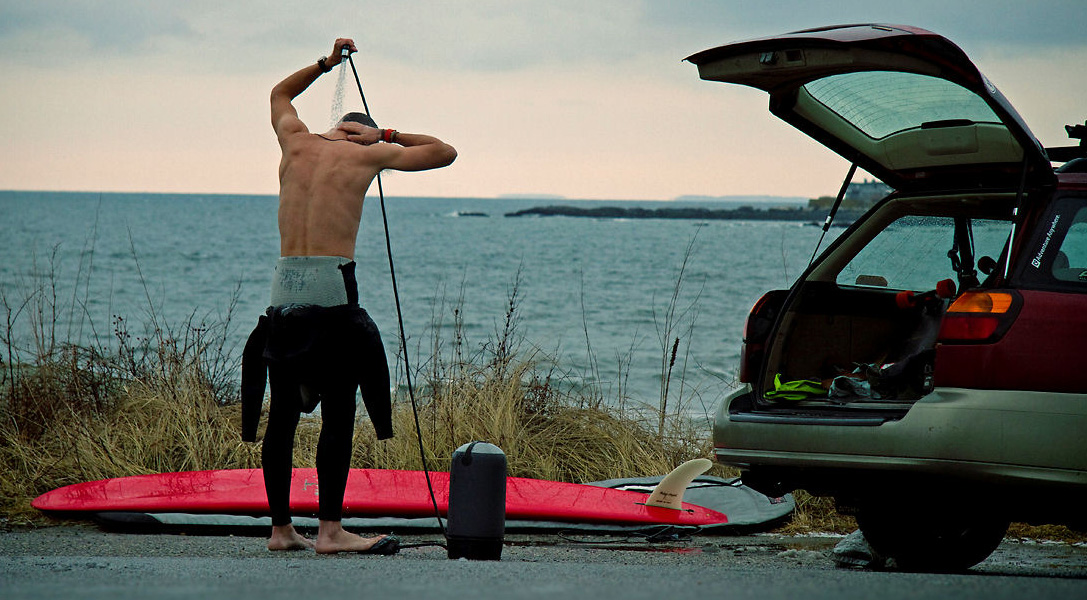
The Nemo Helio Portable Pressure Shower.
Hygiene
Without a doubt, the biggest benefits of having an RV for me fell into the category of hygiene.
Because my RV had its own shower, I could decontaminate easily and quickly anytime I ran into a problematic building or location.
If I woke up in the middle of the night feeling unpleasantly sweaty and toxic, I could easily jump in the shower and then go back to sleep in just a couple of minutes.
The toilet in the RV was a real convenience too, especially when it came to doing coffee enemas.
For laundry, if I was somewhere the did not allow laundry to be hung outdoors on a line, I could make sure it was spun mostly dry and then hang it up in my RV.
I also often washed a few items in my sink and then hung them up in my little bathroom to drip dry.
My RV also gave me room to carry around a good deal of extra equipment, including – at one point – a Wonderwash and a large electric spin dryer.
Even with a van, all of those activities – bathing, toilet and laundry – are going to be much more challenging, requiring some ingenuity and flexibility.
Here is where I am with regard to my plans at this point.

The Scrubba Portable Laundry System Wash Bag.
LAUNDRY
For most of the years that I was on the road camping, I was able to wash my clothes in public laundromats. Then I would take the damp clothes back to my campsite and hang them up to dry either outside or in the RV.
More recently, it has seemed that a fairly high percentage of public washers have become contaminated with a particularly problematic microbial toxin. I therefore have stopped using public washers myself and do not suggest that other people use them either.
A standard approach for mold avoiders who are doing laundry while camping is to wash the clothes either by hand (using a bucket or plastic storage bin) or in a Wonderwash. In some cases, especially if the clothes seem especially dirty, a system such as the Scrubba Portable Laundry System Wash Bag may be used.
After the clothes are washed, they then may be put through a clothes wringer or electric spin dryer before being hung to dry.
While this allows clothes to be washed without the risk of picking up particularly bad cross-contamination from public facilities, it is not an ideal approach. Specifically, the gadgets that are used are fairly expensive and take up quite a bit of room in the vehicle, and the process requires quite a bit of effort.
I therefore started thinking about whether it might be possible to simplify things a bit, at least for my own purposes as well as for the purposes of people who are not yet committed to going on the road full-time.
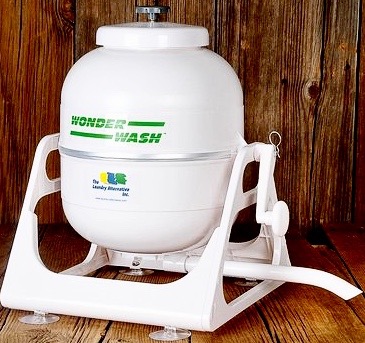
The Laundry Alternative Wonder Wash.
One particularly simple approach that seemed that it might have potential for smaller items (such as shirts, underwear, socks, night clothes, shorts and maybe pants) is the use of a salad spinner to both wash clothes and then to spin them dry.
While it had occurred to me before that the Nina Spin Dryer is basically just a big electric salad spinner, the idea that it might be possible to both wash clothes and then spin them dry in a manual salad spinner – as shown in a video on the topic – was a new one for me.
(From what I can tell, the Avalon Bay Eco Spin is basically a large salad spinner that is marketed specifically for clothes washing. Whether it would work better for this purpose than just using an actual salad spinner – such as the Pykal Large Stainless Steel Salad Spinner – I’m not sure yet.)
Of all the clothes washing methods that I have seen, the salad spinner approach seems to have the most promise for allowing a few clothes to be washed with a minimum of fuss and without any electricity while on the road. I think that once the items come out of the spin dryer, they should dry the rest of the way pretty quickly when hung either outdoors or in the back of the van.
For larger pieces of clothing or for more than just a few items, the “double bucket” method shown in a second video seems to make a good bit of sense to me.
I especially like the idea that people who are not very strong can wring the water out of the clothes by sitting on top of a bucket (rather than having to use their arm strength to wring out clothes by hand or to feed them one at a time through a clothes wringer).
It seems to me that especially if only a few items were wrung out at the time, the “sit on the bucket” method would get things dry enough that they could be hung in the back of the van (which could be convenient when there is not enough time to let things dry out at the campsite or when campsite regulations forbid hanging laundry outdoors).
While toting along a pair of 5-gallon buckets would take up a goodly amount of space in the van, the outside bucket also could be used for carrying water or for other functions at the campsite and could store other items when on the road.

The Avalon Bay Eco Spin.
I always have used clothespins to hang clothes on clotheslines or bungee cords outdoors or inside my RV, but a clothes rack that folds flat also could be considered.
While I still need to try out these new laundry methods to see exactly how they work in practice, I am feeling pretty optimistic that getting laundry done on the road will be much simpler and more pleasant for me as a result of having them available.
A final question with regard to laundry involves cleaning agents used.
Protocols with regard to disposal of grey water (water used for bathing, washing dishes and doing laundry) vary by location, and so it’s a good idea to check on this before proceeding.
In places where pouring grey water on the ground is allowed, this is usually done away from the campsite as well as away from any nearby water sources.
If laundry water is to be thrown on the ground, then only biodegradable cleaning agents should be used.
While some commercial laundry detergents seem to be much more natural than others, I’m not so sure that even the best of them would count as “biodegradable” enough to be poured on the ground in a pristine place.
I feel more comfortable using a homemade laundry detergent consisting of Dr. Bronner’s liquid soap, washing soda, an oxy-type product and maybe some borax when out in the wilderness.
Washing:
Scrubba Portable Laundry System Wash Bag. $55.
5-Gallon Buckets with Lids.
Drying:
Amazon Basics Foldable Drying Rack. $20.
Hand Crank Clothes Wringer. $144.
Clothesline and Clothespins.
Salad Spinner Method:
Pykal Large Stainless Steel Salad Spinner. $39.
Dynamic Manual Salad Spinner, 2 1/2 Gallons. $122.
Chef Master Commercial Salad Dryer with Brake, 5 Gallons. $170.
Electric Appliances:
The Laundry Alternative Mini Countertop Spin Dryer (Electric). $70.
Panda Countertop Washing Machine with Spin Basket (Electric). $80.
The Laundry Alternative Nina Soft Spin Dryer (Electric). $133.
Information:
Alaska Granny – The Salad Spinner Method
Tiny House Listings – The Double Bucket Method
Art of Manliness – The Steinbeck Method
Business Insider – Scrubba Bag Review
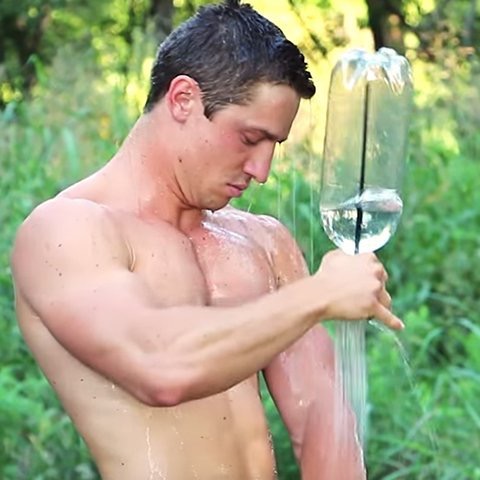
The Simple Shower.
BATHING
When I was tent camping full-time, prior to purchasing an RV with a shower, I used a mix of approaches to get clean on a daily basis.
Sometimes I got lucky and the campground where I was staying had a shower that was tolerable to me.
Frequently, I set up a a tall tent (actually the sleeping part of my L.L. Bean screen room tent) and then did a sponge bath inside it, using a bowl of warm water that I had heated up on my camp stove.
Sometimes I put on a bathing suit and showered outdoors with the Zodi Instant Hot Shower.
On a few occasions, I set up a big shower shelter, filled a large solar shower with water, let the water heat up for a long time in the sun, after a struggle got the heavy bag hung from the ceiling hook in the shelter, and then finally showered off. (That method was a lot of work for not all that much more reward than just taking a sponge bath though, so I gave up on it pretty fast.)
More recently when traveling, I mostly have relied on truck stop showers when hotel or campground showers have not been available to me.
Showers in the large truck stop chains (such as Pilot Flying J, Love’s Travel Stops or TA/Travel Centers of America) invariably have felt okay to me. Although they are a little pricey (about $12 per shower if not filling up a large semi with fuel), the money has seemed well worth it to me.
Large chain truck stops are few and far between in rural areas away from civilization though. I therefore feel like I am going to be prepared to use other methods to get clean for some of my future travels, in case campground showers are not regularly available or usable.
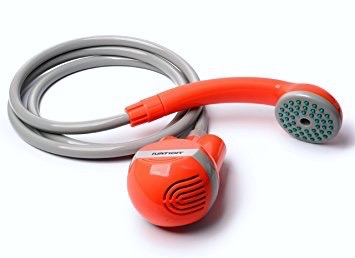
The Ivation Portable Shower.
As long as the outdoor weather is reasonably nice, one possibility is to shower outdoors, similar to how I used to do with the Zodi.
The Zodi did get me nice and clean, but in retrospect it seems to have been overkill to carry around a special system so that a propane tank could heat the water at the same moment that it was being pumped into the shower nozzle.
I now think that it would be simpler to first heat up a pan of water to boiling on my cookstove, and then to dilute the water to the right temperature in a bucket or large pot for showering purposes.
For the pump, I would consider buying the Zodi pump again (but on its own rather than in combination with the water heater component) if I wanted to use D batteries to power the shower.
If I wanted to try a shower with a rechargeable battery, I likely would look at the Iron Hammer or Ivation pump.
Another interesting shower pumping system is the Nemo Helio, which uses only a foot pedal without any battery or electric power at all.
Although I like the idea of the Nemo Helio, and although many users appear to like it too, in reading the reviews it seems that it may have some design glitches that increase the likelihood that it may not last very long. Perhaps one of the simpler and less expensive battery-operated showers that mentioned above would be better, therefore.
For times when I have access to electricity, the Allied Precision Bucket Water Heater – which drops into a bucket and quickly heats the water in it to the desired temperature – could be interesting to try in combination with one of these shower pumps.
An even simpler way to shower would be with a handhold unit that basically just squirts out water, such as the Lunatec Aquabot or the Simple Shower.
Of course, the tried-and-true method of using a bowl of water and a wash cloth for a sponge bath also could be used.

The 2.5 Gallon Summer Shower.
While I would be able to use all these washing methods in the open while wearing a two-piece bathing suit, I might try putting up a privacy shelter so that I can get fully undressed to shower or bathe.
Providing it was staked down properly, a shelter also would be helpful in providing some protection from the elements such as the wind.
Especially if I put up a privacy shelter for showering, I might use a fairly shallow plastic bin to stand in to collect some of the bathing water, so that it can be disposed of away from the bathing area rather than having the ground in that area get really wet.
I also would wear some kind of waterproof shoes such as Crocs, of course.
I think that if I were really careful, it might be possible to succeed in doing a mini sponge bath in the back of the van. I will have to experiment with this idea to see whether I actually feel comfortable doing it though.
Unfortunately, none of these bathing methods seems exactly ideal. For instance, most of these methods seem like they will be feasible only in decent weather, and all of them will require a bit of effort to get set up.
Hopefully, therefore, I will be able to find acceptable public showers to use on my travels most of the time.
Finally, as with the laundry, if grey water from bathing is to be dumped onto the ground, then using biodegradable cleaning agents is important.
The most frequent choice for this is Dr. Bronner’s Magic Soap.
Another good option would be Andrea Fabry’s Just So line of homemade soaps, which is what I use for bathing at home.
The question of which hair care products to use seems a bit more murky, however.

Just So Natural Soaps. (From top: charcoal, plain and seaweed.)
While I went through a phase washing my hair only with Dr. Bronner’s liquid soap, this did not work very well at all in terms of how my hair looked and felt.
While I’ve read in various places that Kiss My Face Whenever shampoo and conditioner (which I often use at home) is biodegradable, I’ve not found any definite evidence of this online.
I would guess that Dr. Bronner’s new line of hair care products (along with their toothpaste) may be biodegradable, but they do not seem to be drawing much attention to that fact if so.
Even though I’m not sure that there are any products out there that are optimal for the task, I feel like I do need to wash and condition my hair and to brush my teeth on occasion when camping.
So unless I come across some new information, all I can see to do is to bring along these kinds of natural products (which are the same ones that I would use at home anyway) and then use a minimum of them when bathing or showering outdoors.
Battery-Operated Showers:
Zodi Outback Gear Battery Powered Shower. $40.
Iron Hammer Portable Camp Shower. $77.
Manual & Pressurized Showers:
Lunatec Aquabot Sport Water Bottle. $28.
Nemo Helio Portable Pressure Shower. $100.
Road Shower Pressurized Solar Shower. $300+.
Sponge Baths:
Washcloths/Sponges.
Water Heating:
Advanced Elements 2.5 Gallon Summer Shower/Solar Shower. $22.
Allied Precision Bucket Water Heater. $44.
Zodi Instant Hot Shower. $190.
Bathing Accessories:
L.L. Bean Personal Organizer Toiletry Bag. $25-70.
Additional Information:
Cheap RV Living – How to Stay Clean
We Are Top 10 – Portable Camping Showers
Hi Consumption – Portable Camping Showers
The Wirecutter – Solar Showers

Camping towels. Image Credit: The Wirecutter.
TOWELS
Conventional cotton bath towels are totally inappropriate for camping, since they dry very slowly after use, need to be hung up somewhere while drying, have the potential of becoming moldy, get dirty easily, take up a lot of space, and tend to be scratchy and uncomfortable when not put through an electric dryer after being washed.
When I was camping, I mostly used the larger size of the REI Multi Towel Lite towels. Those are microfiber towels and dry really fast. (Note that I didn’t much like that company’s regular Multi Towels – just the thinner, flatter Lite version.)

The Anatolian Handmade Turkish Towels.
Corinne from “My Chemical-Free House” brought up the Wolfyok Micofiber Travel Sports Towel, which sounds similar to the REI towel but is somewhat less expensive. I might give that a try this time around.
An in-field camping test by the review blog The Wirecutter looked at a large number of camping towels and was enthusiastic about many towels that are totally unfamiliar to me. I might choose one or two of their recommendations and check them out.
Another popular choice for camping is some kind of Turkish towel. These are thin and dry quickly, and also are usually very comfortable. The organic version sold by L.L. Bean sounds especially interesting.
The Aden Muslin Swaddle Blankets were recommended by a mold avoider as an affordable option that has worked well for her.
Synthetic Fabrics:
PakTowl Personal Microfiber Towel. $7-40.
REI Co-op Multi Towel Lite. $10-25.
Wolfyok Microfiber Travel Sports Towel. $13.
Wise Owl Outfitters Camping Towel. $14-17.
Natural Fabrics:
LL Bean Organic Textured Bath Towel. $20-30.
DII Oversized Peshtemal Turkish Towel. $20.
Nature Is Gift Turkish Peshtemal Towel. $25.
The Anatolian Handmade Turkish Towel. $28.
Aden Muslin Swaddle Blankets. $30.
Additional Information:
The Wirecutter – Best Camp Towels
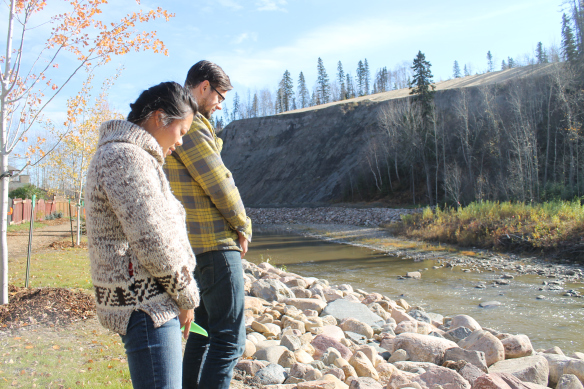
Demonstrating the P Style. Photo Credit: Melba Seto, Melba’s Toast.
TOILET
I’ve not previously put any effort before into thinking about toilet facilities for camping. During the months that I was tent camping full-time, I stayed in developed campgrounds and used the facilities that were available (or ones on the road). Later, I used the toilet in my RV.
Recently, though, I have been thinking about toilet issues.
For one thing, there have been many times on long hikes that having the option of peeing more like a man would have been very convenient. Being able to easily urinate into a bottle when traveling around or spending the night in my van also could be very convenient, I think.
In addition, public facilities appropriate for doing coffee enemas are virtually non-existent unless staying in hotels or maybe using a truck stop shower, and I would really miss them on a long road trip.
For the former issue, there now are a variety of devices on the market that supposedly allow women to be able to urinate while standing up, by directing the flow forward.
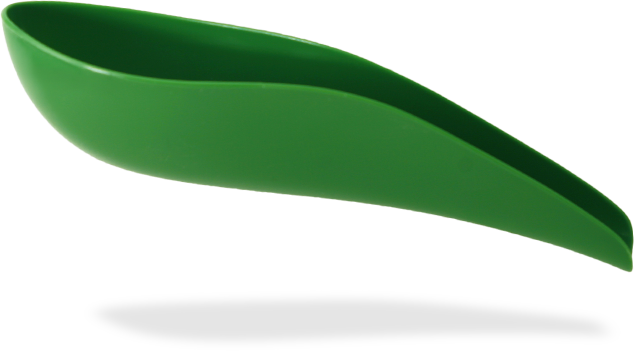
The pStyle.
I recently have been experimenting with one of the more popular devices, called the pStyle, and think that it has some potential. Certainly it seems a better option than finding a hiding place to pull down pants or shorts and then squat while on the trail!
I also think the pStyle would be really helpful when using pit toilets, since squatting over those always has made me squeamish with regard to what might be potentially being splashed back up toward my private parts.
If I could get really skilled at using the pStyle or another urinary flow director, then perhaps I could use it while in my van (storing the urine in a Nalgene bottle or other container to dump out later). I don’t know if that is something that I ever would do very often, but maybe it would be good to have the option just in case.
(Actually, once when I was tent camping in late spring in Arizona, I woke up in the middle of the night and heard a rattlesnake right outside my tent. After that, during that stay, I was afraid to go out of the tent at night and kept a large metal bowl inside with me in case I needed to pee in it. The pStyle definitely would have come in handy during that week of my life!)
The challenge with coffee enemas is that there needs to be a relatively clean and private place to get down on the floor to insert the coffee, and then somewhere to lie on my side for 20 minutes or so, and then there also needs to be a toilet right nearby since it will not be possible to walk more than a few steps before expelling the coffee. There have been very few times indeed that I have managed to find a setup like that at campgrounds, since usually the bathrooms are way too dirty or do not provide enough extended privacy.
I do think that even my little van would provide enough of a refuge to do a coffee enema privately and comfortably though, provided that I had a travel toilet in the van.
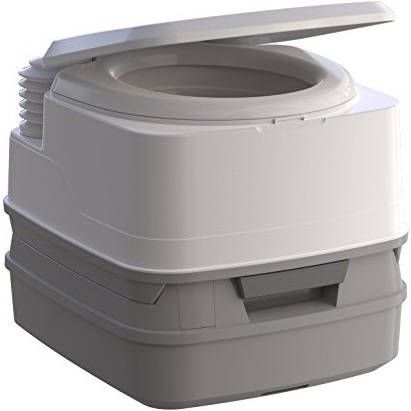
The Thetford Porta Potti 260B.
I then could (and probably would) almost immediately remove the waste tank from the toilet and dump it out in the public toilet. I am thinking that I would probably bring along a jug of water to be able to rinse off the tank a bit after emptying it out and before bringing it back to the van.
There are a number of similar travel toilets on the market. I am thinking about the Camco one, mostly because a video provided by the manufacturer has provided me with a pretty good understanding of how the toilet works.
I think I would definitely want the smaller Camco tank size (2.6 gallons), if for no other reason than that it would be easier to carry it discretely to a public restroom to be dumped out. The small tank results in a toilet that is very low if it is placed on the ground, but apparently the whole toilet could be placed on the top of a 5-gallon bucket to add extra height if desired.
Probably I also would want Camco Standard rather than Camco Premium toilet, so that it takes up a minimum amount of space in my van. (The Premium version may be more appealing to those who do not like the idea of perching on a small toilet seat though.)
I feel like the toilet needs its own case, so that it can be put out of sight except for the infrequent occasions when I will be using it. The Leopard Storage Toilet Bag is intended for a toilet with a larger storage tank, but maybe I could keep some supplies (such as toilet paper or tank additives) in the extra space.
Another storage option could be a plastic bin, with the online measurements suggesting that the Sterilite 54-Quart Gasket Box might work.
Both of these options would work only for the Camco Standard toilet. The Camco Premium toilet would need a larger storage container, such as the Sterilite 80-Quart Gasket Box.
Especially if I were not always going to be able to clean out the toilet immediately after using it, I would add to the storage tank some kind of natural-type digestive treatment using enzymes and/or microbes, maybe along with some Dawn dish soap, to break down the waste. (When I was living in the RV, I found that if I put homemade milk kefir in my black water tank, it did not smell at all. The commercial alternatives do not work as well as the kefir, in my experience, but I’m not sure that I’m going to be set up to be making kefir on the road in my van all the time.)
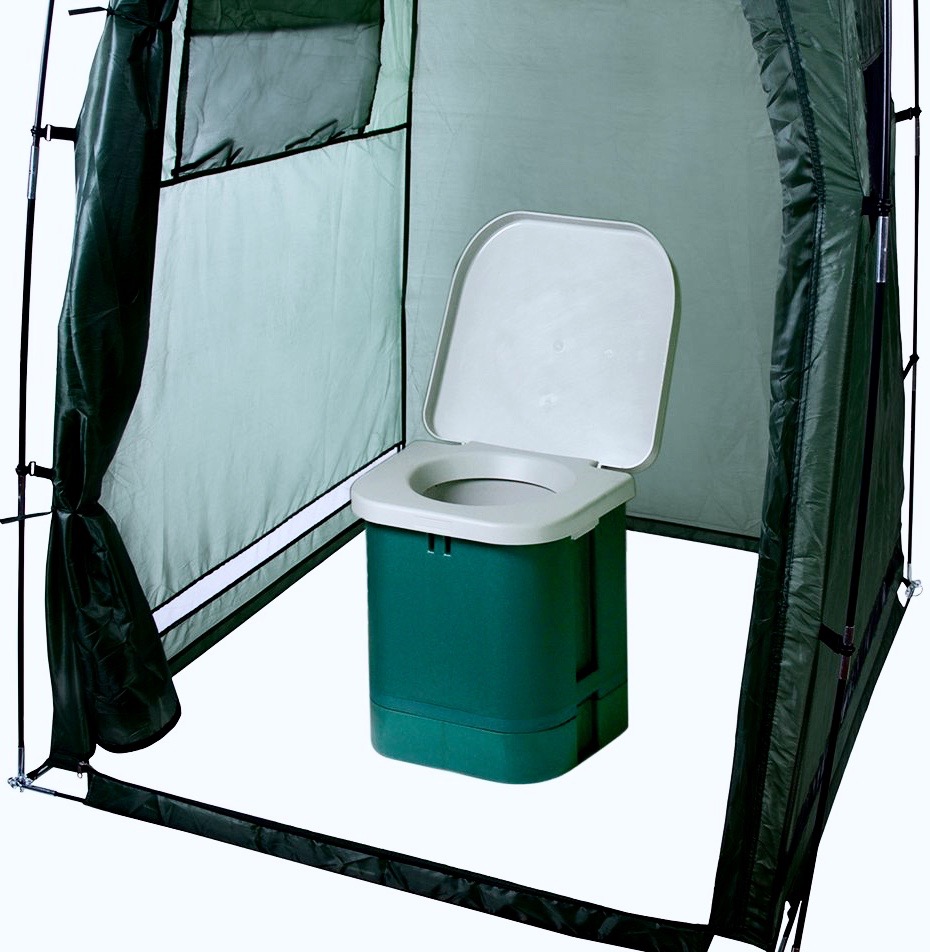
The Stansport Portable Camp Toilet.
Although it’s conceivable that I might use a portable toilet to urinate in on the road (especially if I do not become wholly skilled at using the pStyle or other similar device), it doesn’t seem like it would be a good idea to use a portable toilet for ordinary bowel movements since the solids would take a while to dissolve even with the digestive treatment.
Rather, if I ever thought I would need an option for that (for instance, when “boondocking” away from civilization), then likely I would line the toilet bowl with a trash bag filled with unscented cat litter, so that I could just bag the whole thing to be thrown in the garbage when I was done.
I haven’t tried this method and also haven’t owned a cat for many years, and so I’m not sure what kind of cat litter would be best. If I were going to experiment, I might start with Cat Spot Litter, which is unscented, made out of coconut, super-absorbent, and available in small bags.
A higher-tech (if relatively expensive) but similar alternative to the trash-bags-and-cat-litter approach would be the Reliance Double Doodie Toilet Waste Bags.
Urine Direction & Storage:
Nalgene Wide-Mouth Water Bottle. $7+.
Firstergo Portable Urinal. $8.
Arunners TM Urinal Bottle. $11.
pStyle Stand-to-Pee Device. $13.
pCase – Carrying Case for pStyle. $11.
Freshette Female Urinary Director. $25.
Composting Toilets:
Nature’s Head Composting Toilet. $960.
Self-Contained Toilets:
Camco Standard Portable Travel Toilet, 2.6 Gallons. $65.
Camco Premium Portable Travel Toilet, 2.6 Gallons. $69.
Thetford PortaPotti 260B Portable Toilet. $95.
Self-Contained Toilet Storage:
Sterilite 54-Quart Gasket Box. $13.
Sterilite 80-Quart Gasket Box. $15.
Leopard Outdoor Waterproof Portable Storage Toilet Bag. $15.
Bucket Toilets:
Reliance Portable Snap-On Toilet Seat. $17.
Reliance Hassock Portable Lightweight Toilet. $37.
Reliance Luggable Loo Portable Toilet. $38.
Stansport 273-100 Portable Camp Toilet. $76.
Cleanwaste Go Anywhere Portable Toilet. $100.
Waste Dissolvers:
Unique RV Digest-It Holding Tank Treatment. $15.
Happy Campers Organic RV Holding Tank Treatment. $23.
Bucket Toilet Waste Absorption:
Hartz Home Protection Training Pads. $13.
Amazon Basics Pet Training and Puppy Pads. $17+.
Reliance Double Doodie Toilet Waste Bags. $18.
Next Gen Green Tea Fresh Cat Litter. $22.
Cleanwaste Mini Bulk Poo Powder Waste Treatment. $36.
Peat Moss.
Sawdust.
Stove Pellets.
Toilet Paper:
Scott Septic Safe Toilet Tissue.
Information:
Bear in Forest – Portable Toilets
Gear Ware – Portable Camping Toilets
Cheap RV Living – Pooping in a Car, Van or RV

The Nemo Heliopolis. (Photo Credit: Christophe Noel/Expedition Portal.)
Privacy Shelters
Although I briefly owned a privacy shelter (a large one from Cabela’s) early in my camping experience, it took up so much room in the car and was so much trouble to put up that I soon gave it away.
I mostly stayed in hot springs or other campgrounds with shower facilities while I was tent camping, and then after that I just used the bathroom in my RV.

The Lightspeed Outdoors Privacy Tent.
However, many more people are camping off-grid these days, due in large part to encountering problems with campground and RV park septic systems.
A privacy shelter that sets up quickly and easily – and that preferably takes up very little room in the car – thus may come in handy for both showering for toilet facilities.
A new style of shelter that I do not recall seeing in the past seems to fold down super-compactly and to pop up into a full-size shelter pretty easily.
Quite a few companies – including Wolfwise, KingCamp, Green Elephant, Partysaving and Copper River – sell this kinds of shelter.
Whether some of these shelters are better than others, I’m not sure.
In reading the reviews, it looks like the main challenge with these shelters is that that there is a little trick to getting them to fold back up again.
Cabela’s (which sells the Copper River version) created a video on the topic that I thought was especially informative, and so hopefully if I purchase one of these, I will be able to figure it out.

The Green Elephant Popup Utilitent.
In looking information about these shelters, one factor that I see that might be important is how opaque the fabric is.
Some of these shelters seem to be made of material that allows light to permeate, potentially decreasing the level of privacy actually being experienced by users of the shelter.
For that reason, a shelter that is made of darker material and/or two layers of material – such as the Partysaving version – might be preferable in at least some circumstances.
Of other privacy tents available, I think that the Lightspeed might have some promise. It would take more room in the van than the other units, but at least it does not look too difficult to put up. I
t also looks stable enough that it might support the weight of the bag of a small solar shelter – something that would be disastrous for the previously discussed shelters.
Another apparently sturdier privacy shelter is the KingCamp Oversize Easy Up Dressing Tent. It sets up with poles like a tent and then folds down reasonably compactly (26″ x 6″ x 6″) for storage.
VanDwelling guru Bob Wells put up the Texsport Instant Privacy Shelter in the Cheap RV Living video on shower enclosures, and it also looks pretty solid.

An opened real liftgate door of a Ford Transit Connect cargo van seems to have potential as the basis for a shower shelter.
Some of the other discussion in that particular video has me thinking that since the rear door of my Ford Transit Connect cargo van lifts high into the air, probably I could clip a tarp to the edges of it (to serve as a shower curtain) and then use the makeshift shower stall with a pump-operated shower.
My feeling on this is that if I didn’t want the ground area in back of my van to get really wet, I could stand inside one of my plastic storage containers while showering and then dump the water elsewhere after I was done.
As described in the video, a van with fold-out doors also would work with regard to rigging up a shower right in back of the van, with just a couple of extra supplies required.
Probably I will give this idea a try sometime soon, since it sounds like it would be lot less trouble than using a separate shower shelter that I would have to carry around in the van.
Nemo:
Nemo Heliopolis (Amazon). $150.
Nemo Heliopolis (Moosejaw). $150.
Ozark Trail:
Ozark Trail Shower Utility. $45.
Ozark Trail 2-Room Non-Instant Shower. $79.
Ozark Trail 2-Room Instant Shower/Utility. $110.
Small Pop-Up Shelters:
Wolfwise Pop-Up Shower Tent. $30.
Partysaving 6 Feet Portable Privacy Popup Room. $31.
KingCamp Portable Pop-Up Privacy Shelter. $43.
Green Elephant Popup Utilitent. $50.
Cabelas Copper River Fold A Privy. $70.
Privacy Tents:
KingCamp Oversize Easy Up Dressing Tent. $95.
TexSport Instant Privacy Shelter. $96.
Lightspeed Outdoors Privacy Tent. $110.
Van Shower Enclosure:
Megadeal Heavy Duty Spring Metal Clips. $7.
CMS Magnetics Ceramic Magnets. $13.
Videos:
Cabela’s – Pop-Up Tent Assembly Video
Cheap RV Living – Potty/Shower Enclosures, Pt. A
Cheap RV Living – Potty/Shower Enclosures, Pt. B
More Information:
Expedition Portal – Nemo Heliopolis