
The Living Clean Guide to Non-Toxic Camping Gear (Part 6) – Preparing & Serving Food


The Breville Compact Juice Fountain.
ELECTRIC APPLIANCES
Although I carried along both a Vitamix and an Omega juicer in my RV for quite a while (and at one point set up a whole “juice bar tent” to use them in), those items are both so bulky that I wouldn’t especially recommend bringing them along unless a trip is designed to center around juicing.
If folks really want a blender for smoothies, a more compact appliance like the Oster My Blend (which seems to be very popular and is available on Amazon at the time of this writing for less than $20) seems like it would be a better choice for travel purposes.
For juicing, I suggest the Breville Compact Juice Fountain. It is a centrifugal rather than masticating juicer and also requires the lid to be removed to scoop out the pulp, but it is fairly compact and, I feel, makes pretty good-quality juice.
A hand blender takes up very little storage space. I use mine mostly for pureeing vegetable soups (usually made with vegetables cooked in the Instant Pot), but it also could be used for creating smoothies or coffee drinks, whipping egg whites, or making sauces or mayonnaise.
I currently have the Hamilton Beach Hand Blender and it has been fine, but if I could do it over again, I would have spent the extra couple of dollars and to get the same model with the 3-cup food chopper attachment it to try it out.
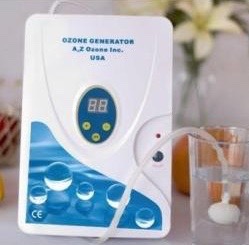
The A2Z Ozone Generator.
Whether it ever would be worthwhile to bring a food processor on a camping trip, I don’t know. However, I have the Hamilton Beach 4-Cup Compact Food Processor at home, and it works well enough and is small enough that it seems that it could be worth considering in some circumstances.
A big problem for me on the road in remote locations was getting access to high-quality organic produce.
However, my experience was that if I soaked my produce in a tub of water with a water ozonator running in it for a little while, it would last much longer (in some cases, basically indefinitely until it dried up).
I may bring my little water ozonator on the road with me just for this purpose, therefore.
A good thing about the water ozonator is that it is very low wattage and so could be used when even a small amount of battery power is available.
As discussed in an article that I wrote about ozone therapy, this product mostly seems relevant for washing produce rather than other uses.
Electric Appliances:
Hamilton Beach Hand Blender, 225W. $28.
Hamilton Beach Hand Blender with Food Chopper, 225W. $30.
Hamilton Beach 4 Cup Compact Food Processor, 250W. $39.
Oster My Blend 250-Watt Blender with Travel Sport Bottle, 250-400W. $41.
A2Z Ozone Aqua 6 Multi Purpose Ozone Generator, 10W. $70.
Breville Compact Juice Fountain, 700W. $100.
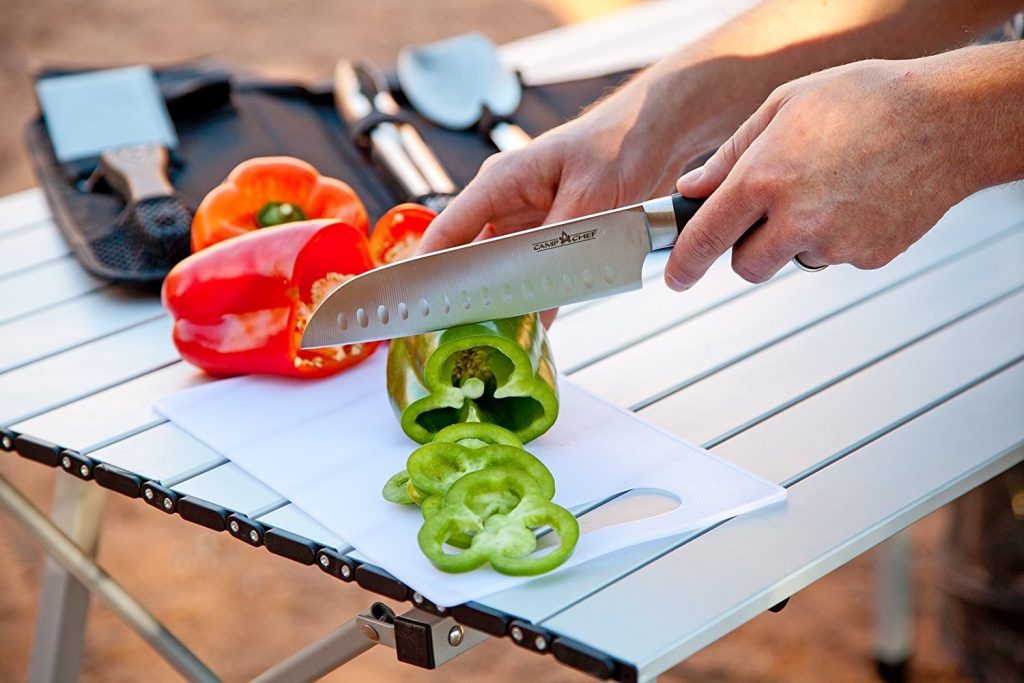
The Camp Chef All-Purpose Chef’s Set.
KITCHEN EQUIPMENT
At least in my experience, living in a house with a reasonable number of cabinets and closets, it’s easy to get carried away with cooking equipment.
When on the road though, paring the equipment down to essentials that can be used over and over again is important, in terms of storage space as well as being able to easily find and access needed items.
Ideally, there would be as few pieces as possible to accomplish the necessary tasks, with the pieces being as compact as possible while still being functional.
STORAGE CONTAINERS
Although I am not a fan of plastic in general, I do often store leftovers in plastic containers (but then always reheat those leftovers in a pot on the stove).
Usually I just use inexpensive semi-disposable ones from Glad, from Rubbermaid or from Ziploc.
Since those storage containers nest inside one another, they don’t seem to take up that much room when not being used.
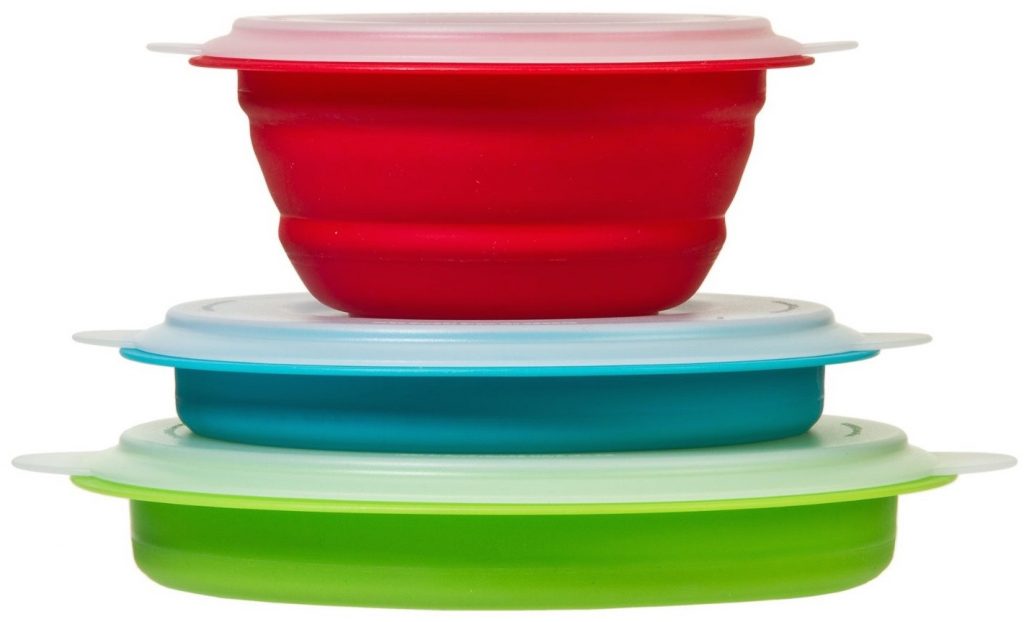
Prepworks by Progressive Collapsible Silicone Containers.
Conceivably I might try collapsible silicon containers as an alternative though, since they would be more compact and maybe have fewer toxicity issues since silicone is supposedly safer.
Stainless steel storage containers would be very nice from a toxicity standpoint, but also are fairly expensive and tend to take up a fair amount of space when not being used.
I’d be interested in alternative ideas on how other people store their own leftovers when on the road.
When tent camping with a cooler, I usually try to bring along storage for at least a couple of dozen eggs.
In my experience, storing eggs in their cardboard container in a cooler tends to not work out very well because good intentions to the contrary, the container almost always ends up getting wet.
However, many camping egg containers have not worked out for me because they are not intended for larger eggs.
Although I have never tried the Lock & Lock version, one customer on the Amazon site reports that it can accommodate extra-large chicken eggs.

The Lock & Lock Egg Storage Container.
An alternative solution is to use the foam carton from a dozen cheap eggs purchased at a regular grocery store.
Even when I have appropriate egg storage, I tend to hard cook most of my eggs pretty soon after purchasing them and then to eat them a few at a time.
The reason for this is that eggs that I feel are good enough to eat (from pastured chickens living on small family farms and consuming only organic supplemental feed) usually are not easy to find when I am on the road.
I therefore tend to buy a few dozen such eggs when I come across them, and then use hard cooking to help protect most of them against spoilage or breakage.
Plastic Food Storage Containers:
Rubbermaid Takealongs Food Storage Containers
Ziploc Food Storage Containers
Silicone Collapsible Food Storage Containers:
Prepworks by Progressive Collapsible Bowls with Lids (Set of 3). $11.
Thin Bins Collapsible Containers (Set of 4). $18.
Stainless Steel Food Storage Containers:
Klean Kanteen Food Canister, 8-16 oz. $19-21.
Stanley Adventure Vacuum Bowl, 18-32 oz. $25-30.
Stanley Adventure Canister Set (Set of 3). $30.
Egg Storage:
Lock & Lock Egg Storage Container. $8.
COOKING UTENSILS
To cover most kinds of cooking, I suggest just a few basic utensils: a pancake turner, a serving spoon, a soup ladle, a set of tongs, and some kind of implement (such as a wooden spoon or heat-proof spatula) that can be used for stir frying.
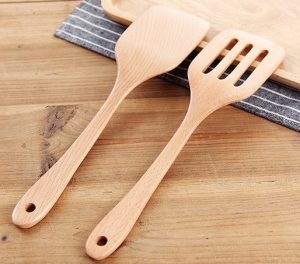
The Bamber Wooden Spatula Set.
Because other forms of cooking potatoes (such as baking or frying) are more difficult than boiling potatoes on the road, and because I am enthusiastic about potatoes in general, I suggest that a potato masher may be worth bringing along as well.
The choice of materials may depend on the types of pans being used and on the types of cooking being done, as well as on factors such as size/weight, apparent toxicity potential and price.
I think that wood is a nice material for utensils, since it tends to be versatile and non-toxic and not very expensive.
I mostly use wood spoons and spatulas for cooking and feel like I should think about getting some additional tools (including a turner, a soup ladle and some tongs) made of wood.
I also use metal frequently, but the challenge here is that many of the products offered by reputable companies – like OXO Good Grips – are on the large and heavy side. Although there are smaller versions available in some cases, I don’t always trust the companies that are offering them.
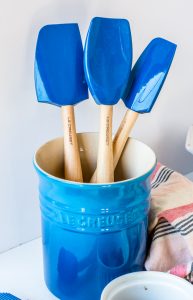
A collection of Le Creuset Revolution Silicone Spatula Spoons.
Of course, with some kinds of pan finishes (though not the ones that I use), metal utensils should be avoided.
Nylon is a light and usually inexpensive material, and several camping companies make compact-sized cooking utensils out of nylon.
Although I would not avoid using nylon implements at all costs, I don’t feel especially good about using them from a toxicity perspective though.
Silicone is a newer material that is often said to be safer with regard to health issues than synthetics such as nylon.
I used a Le Creuset silicone spatula spoon for a while. While it was pretty and nicely made, I can’t say that I ever felt great about it. Eventually I gave up on it and went back to wood, and I’m not that excited about using anything else made of silicone for cooking purposes either.
In writing this article, I spent some time online and picked out various utensils from each category that sounded like they could be good purchase choices.
Otherwise, I likely would have just gone to Target or Walmart at some point to pick up what I needed, without putting much thought into it.
The advantage with that approach would have been that I would have been able to view each item and therefore more easily get a sense of its quality and size than I have been able to do looking at information online.
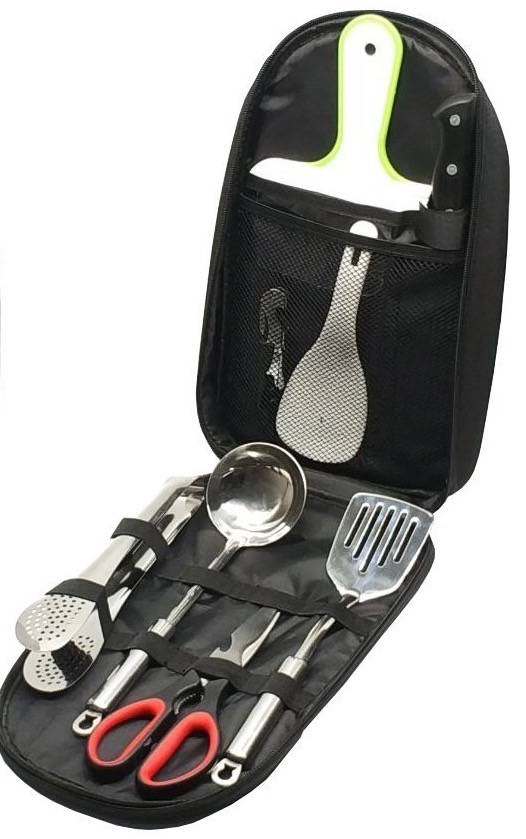
The Gold Armour Camping Cookware Set.
However, now that I have put some time into researching this topic, I am interested in buying a few new wood items and maybe also a camping kit with compact versions of frequently used utensils.
A camping kit seems like it could be especially useful to have on hand when I want to prepare or reheat a simple meal on the road, without having to dig through my storage bins to find the right regular-sized utensils.
Ideally, I would have within easy reach a small bag containing a one-burner stove and propane tank, a single pot, my utensil kit, a plate/bowl and some silverware.
That way, I could cook something simple whenever I had the urge, without wasting a lot of time or making a big mess of my storage system.
A problem, however, is that I don’t especially trust most of the companies selling utensil kits to provide either decent product quality or a combination of items that will fulfill my needs.
However, because I’ve found it difficult to find an empty case that would allow me to create my own set, I might try buying one of these pre-made sets (maybe the Camp Chef, the Da Benben or the Gold Armour one) with the upfront plan of replacing the utensils that don’t work for me with better versions.
Wooden Utensils:
OXO Good Grips Wooden Spoons. $6-10.
Lohome Natural Wood Soup Ladle. $9.
Eddingtons Italian Wood Serving Utensils. $10+.
Garcoo Non-Stick Wooden Spatulas Set. $10.
OXO Good Grips Wooden Turner. $11.
Berard Olive Wood Handcrafted Curved Spatula. $11.
To-Go Ware Bamboo Travel Utensils. $12.
Bamber Wooden Spatula Set. $13.
Metal Utensils:
OXO Good Grips Stainless Steel Utensils. $9-12.
OXO Good Grips Brushed Stainless Steel Utensils. $11.
OXO Good Grips Stainless Steel Locking Tongs. $12.
Nylon/Synthetic Utensils:
Coleman Nylon Serving Set (3 Pieces). $5.
GSI Outdoors Mini Spatula. $8.
GSI Outdoors Ring Set (3 Pieces). $11.
Farberware Classic Mini Tools (4 Pieces). $11.
GSI Outdoors Pivot Spatula. $12.
GSI Outdoors Pivot Spoon. $16.
Silicone Utensils:
Star Pack Premium Spatula (2 Pieces). $9.
Star Pack Premium Spoonula. $13.
OXO Good Grips Cookie Spatula. $9.
OXO Good Grips Small Spoon. $9.
OXO Good Grips Flexible Turner. $11.
OXO Good Grips Turner, Spatula & Tongs Set (3 Pieces). $14.
Le Creuset Revolution Silicone Spatula Spoon. $20.
Snow Peak Silicone Spatula. $22.
Star Pack Home Kitchen 10.6″ Utensil Set (5 Pieces). $23.
Potato Mashers:
OXO Stainless Steel Potato Masher. $12.
2-in-1 Mix-N-Masher Stainless Steel Potato Masher. $12.
Calphalon Nylon Potato Masher. $20.
Utensil Camping Sets:
Da Benben Camping Travel Cooking Utensils Set, 8 Pieces. $22.
Gold Armour Camping Cookware Kitchen Utensil Organizer Travel Set, 8 Pieces. $22.
Chanodug Camping Kitchen Utensils Set, 10 Pieces. $29.
Wellmax Camping Cookware Set, 10 Pieces. $30.
Camp Chef All-Purpose Chef’s Set, 5 Pieces. $33.
Forest Master Camping Cookware Utensils Set, 8 Pieces. $34.
GSI Outdoors Crossover Kitchen Set, 12 Pieces. $35.
GSI Outdoors Destination Kitchen Set, 24 Pieces. $50.
Primus Campfire Prep Set, 6 Pieces. $68.
KNIVES
It seems to me that for the sake of simplicity, having just two or maybe three knives when camping is likely the best idea.
A more difficult question, though, is what kind of knives those should be.
In some cases – as is the case with me at present – people who are planning a trip into the wilderness already have knives that they use regularly in their homes.
Although it may be that these knives could be put into a knife roll and brought along on a camping trip, I personally am a little hesitant to do that since the knives I use most frequently are large and heavy, and also since I am afraid that they may be damaged or lost.
Possibly, smaller and less expensive knives would be a better choice.
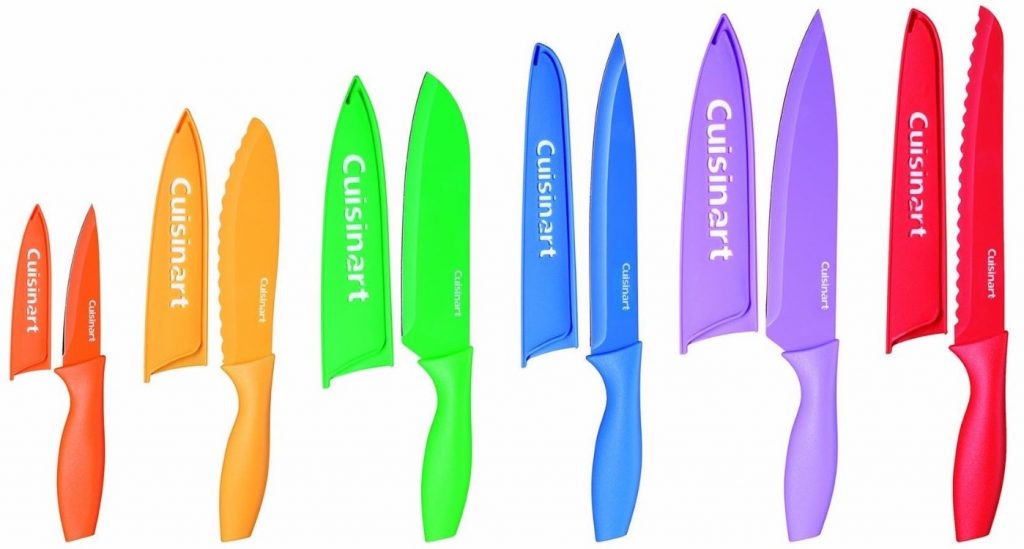
The Cuisinart Ceramic Knife Set.
In other cases, people own knives that they have previously used but are putting them aside along with their other possessions for a mold avoidance sabbatical.
Of all the possessions that mold-sensitized people own, it may be that knives are among the ones that are most likely to ultimately be salvageable.
Therefore, for those people, buying or borrowing some inexpensive knives to use on a temporary basis could be a good strategy.
On the other hand, if people want to create a setup to be comfortable while doing extended camping, then investing in a couple of higher-quality knives and then making an effort to take good care of them while on the road could be a strategy worth considering.
In some respects, ceramic knives – which I have yet to try – seem like they may be a natural choice for camping.
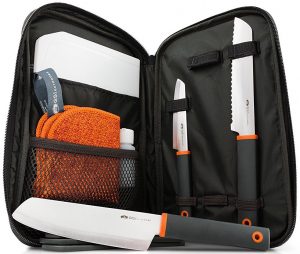
The GSI Outdoors Santoku Knife Set.
For one thing, in many cases ceramic knives have covers on them that make them appropriate for travel use.
They also are quite inexpensive and (in my opinion) semi-disposable, which means that if they get lost or broken it won’t be much of a loss.
At least toward the beginning of their lives they are reported to be very sharp (maybe too sharp – please be careful with them!) and seem to be well-liked by most purchasers.
Although I don’t feel especially secure in the idea that ceramic non-stick cookware is as safe or as durable as many marketers seem to be suggesting, ceramic knives seem like they may have a little more promise.
Many of these knives get really good consumer reviews, and I am a little less concerned about toxicity issues with regard to knives than I am with pots and pans since they are in contact with food only briefly and not at high heat.
While I would not be surprised at all to find that the versions of ceramic knives using bright colors (such as the Cuisinart and Amazon Basics lines) have some heavy metals or other toxic elements in them, again the fact that the food is in contact with them for such a short period of time lessens my concerns to some extent.
For the sake of simplicity, I would prefer when camping to have just two knives – a larger knife like a chef’s knife or a santoku knife, and a smaller knife like a paring knife.
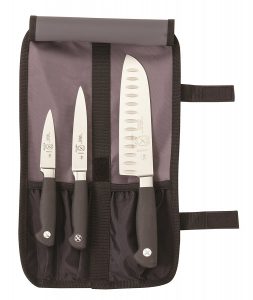
The Mercer Culinary Genesis Forged 4-Piece Starter Set.
From that perspective, both the Cuisinart and the Amazon Basics sets contain many more knives than I need. Maybe I could just give away the extra knives though, or put them aside for possible use later on.
Or perhaps a set with plain-colored blades and fewer knives (such as the Cook N Home or Kyocera Revolution offerings) would be a safer and more practical choice.
For those who would prefer not to use ceramic knives, Zyliss sells at reasonable prices a few sets of knives with high-carbon steel blades and blade covers.
GSI Outdoors recently introduced a promising Santoku Knife Set ($40) specifically for camping purposes. It includes a 6″ santoku knife, a 6″ serrated knife, a 4″ paring knife, a small cutting board, a dish cloth and a small bottle intended for soap. Each of the knives has its own sheath, and all the items are packaged up neatly in a nylon case.
For mid-range conventional knives, Mercer makes a variety of forged knives that are often used by students in training to be chefs. I purchased several of them last year and think they have worked out fairly well, at least considering what I paid for them.
The Mercer Genesis Starter Set (which has three knives in a travel case and sells for about $80) could be a good choice to bring on the road, for instance.
Victorinox, which makes Swiss Army knives, is another mid-range brand. I really like their lightweight paring knives, and the larger knives are supposed to be pretty good too.
For higher-end knives, I really like Wusthof’s Classic and Classic Ikon knives. (Those two lines of knives are the same except for the handles.)
While I’m not sorry that I went with Mercer for knives that I do not use very much (such as carving and bread knives), it is seeming to me that for knives that are used multiple times per day, it may be worth spending extra for the Wusthof knives.
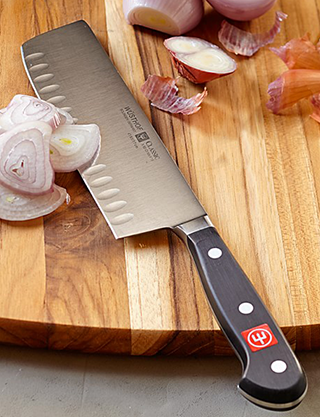
The Wusthof Classic 7″ Nakiri Knife.
For instance, I currently have a Wusthof Classic Ikon 5″ Santoku Knife and feel really good about it every time I use it.
I therefore am thinking that maybe it would be nice to upgrade my Mercer 7″ Nakiri Knife (a big vegetable cleaver that I use several times per day) to the Wusthof Classic or Wusthof Classic Ikon version.
(The Wusthof Classic Nakiri has historically been Pioneer Woman’s signature knife, though recently Walmart has started selling a much less expensive Nakiri knife under her brand name.)
Although the 7″ Nakiri is a little large to take on the road, I am tempted to try the Wusthof Classic 5″ Nakiri since I really like that style of knife for chopping vegetables.
For more general camping cooking, a 6″ Chef’s Knife or a 5″ Santoku would be compact and appropriate for a wide variety of cooking tasks.
Either the Wusthof Classic Chef’s Set or the Wusthof Classic Mini Santoku Asian Set would be good in terms of the knife selection and quality. However, neither of these comes with a travel case.
The Wusthof 7-Piece Gourmet Traveler Knife Set seems like it would be especially functional for use on the road. It includes three knives (a 6″ chef’s knife, a 5″ serrated utility knife that could be used for bread, and a 3″ paring knife), along with scissors, a corkscrew and a mini-knife sharpener, all in a carrying case. I can see myself using all of those items almost every day and not needing anything else.
A downside is that these knives are from the company’s Gourmet line, meaning that they are stamped rather than forged and not professional quality.
I have never used any knives from the Gourmet line and conceivably they could be fine though.
Although the Wusthof Classic Traveler’s Set seems to have been discontinued, a number of Internet vendors are still listing it as available.
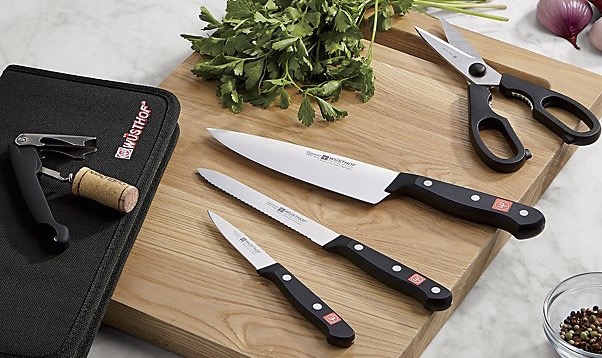
The Wusthof Gourmet 7-Piece Traveler Knife Set.
Unfortunately though, in a number of cases customers have reported buying the sets and receiving Wusthof Gourmet rather than Wusthof Classic knives, and so some caution may be warranted here.
I would guess that a true Classic Traveler’s Set likely would cost more than $200, though maybe there are some out there for less than that.
The case for the Wusthof Traveler’s Set is available on its own for $20. While I’m not sure whether a Santoku or Nakiri knife would fit inside it, with the addition of a Wusthof Classic Chef’s Knife (currently $60) and a few other pieces it could make a nice set.
Ceramic Knives:
Amazon Basics Ceramic Knife Set, 6 Knives. $15.
Cuisinart Ceramic Knife Set, 6 Knives. $17.
Cook N Home Ceramic Knife Set, 4 Knives + Peeler. $25.
Kyocera Revolution Series Paring and Santoku Knife Set, 2 Knives. $65.
Classic Mid-Priced Knives:
Victorinox Paring Knives. $5+.
Zyliss Santoku Knife Set, 2-4 Knives. $14-20.
GSI Outdoors Santoku Knife Set, 3 Knives + Additional Items. $30.
Victorinox 7 Inch Swiss Classic Santoku Knife. $33.
Mercer Culinary Genesis 7-Inch Forged Nakiri Usuba Vegetable Cleaver. $46.
Mercer Culinary Genesis Forged Starter Set, 3 Pieces + Case. $80.
Wusthof Knives:
Wusthof Classic Chef’s Knife, 6″. $60.
Wusthof Classic Nakiri Knife with Hollow Edge, 5″. $74.
Wustof Classic 5″ Nakiri & 4.5″ Asian Utility Knife Set, $100.
Wusthof Classic Santoku Hollow Edge Knife, 5″. $100.
Wusthof Classic Santoku Hollow Edge Knife, 7″. $110.
Wusthof Classic Nakiri Knife with Hollow Edge, 7″. $128.
Wusthof Classic Chef’s Set, 2 Knives. $130.
Wusthof Classic Mini Santoku Asian Knife Set, 2 Knives. $130.
Wusthof Classic Ikon Mini Santoku Asian Knife Set, 2 Knives. $140.
Wusthof 7-Piece Gourmet Traveler Knife Set, 3 Knives + Additional Items. $140.
Additional Wusthof Classic and Classic Ikon Knives
Knife Cases:
Ergo Chef 5 Pocket Chef Knife Case. $16.
Noble Home & Chef Knife Roll Bag. $18.
Wusthof Black Knife Traveler Storage Case. $20.
OTHER KITCHEN EQUIPMENT
For kitchen gadgets – vegetable peeler, pepper grinder, grater, can opener – I mostly just buy OXO Good Grips items because I consistently have been having good experiences with that brand.
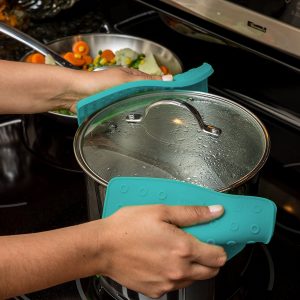
A set of Love This Kitchen Premium Silicone Trivet Mats.
While I would prefer to have more compact items for the sake of camping, I’m not sure that it matters enough to try something else since all of those items are flat or pretty small to begin with.
In the interest of saving storage space (and also in always having a fresh surface to work even between rounds of doing dishes), I think that having a selection of cutting mats – maybe in a few different sizes – on hand is a lot better for camping purposes than toting around a heavier cutting board.
Although they take up some space, plain stainless steel bowls can serve a variety of functions and may be worth bringing along. I used stainless steel bowls frequently for taking sponge baths, for instance.
However, silicone mixing bowls would take up much less space and would store neatly away in my storage bins when not in use.
A collapsible silicone colander or strainer actually sounds like a pretty good idea and therefore is likely something that I will buy (unless I buy a set of nested cooking pots that includes a strainer).
Purely from a usage perspective, I usually prefer simple square cloth potholders or maybe cloth oven mitts.
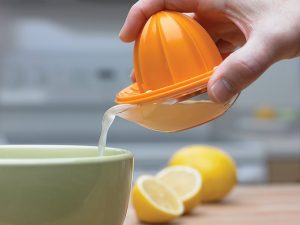
The Prepworks Citrus Juicer.
However, for camping purposes, I am thinking that silicone pot holders probably are a better idea since they are so much easier than cloth ones to wash. I should buy some more of those, I think.
I like Stanley products in general, and am thinking that – even if I am not planning to make mixed drinks that often – the Stanley Happy Hour Shaker Set (which includes a citrus juicer) could be useful for making fresh lemonade and also for fresh orange juice.
Otherwise, I would want to bring along a small citrus juicer – such as the one made by Prepworks – since I have reasonably frequently run across good-quality citrus appropriate for juicing on the road.
Gadgets:
OXO Good Grips Vegetable Peeler. $10.
OXO Good Grips Can Opener. $14.
Strainers:
OXO Good Grips Silicone Collapsible Strainer or Colander. $18-25.
Cutting Boards/Mats:
CounterArt Flex Cutting Mat (Set of 4), Mini. $5.
CounterArt Chop Chop Flexible Cutting Mats, 9 x 12″. $9.
OXO Good Grips Prep Cutting Board. $9.
Epicurean Kitchen Series Cutting Board, 8″ x 6″. $12.
Mixing Bowls:
Squish Mixing Bowl, 1.5-5 Qt. $12-20.
Fox Run Stainless Steel Mixing Bowl. $6-24.
Potholders:
Lodge Striped Hot Handle Holders/Mitts (Set of 2). $8.
Ankway Silicone Pot Holders. $12.
YiLife Premium Silicone Pot Holder. $13.
Love This Kitchen Premium Silicone Trivet Mats. $13.
Le Creuset Silicone 8″ Round Cool Tool. $16.
Alcoholic Beverages:
Stanley Happy Hour Shaker with Four Cups. $35.
OXO Steel Double Lever Waiter’s Corkscrew. $15.
HiCoup Kitchenware Wing Corkscrew. $11.
Bottle Opener.
Additional Information:
The Wirecutter – Best Corkscrews
Outdoor Gear Lab – Ultimate Camp Kitchen
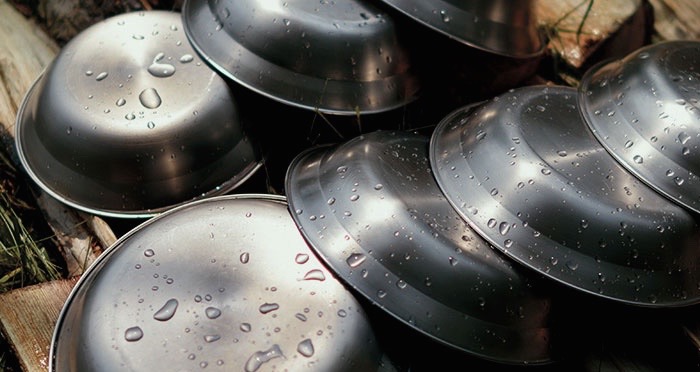
Snow Peak stainless steel bowls.
TABLEWARE
One challenge with camping is that the dishes and glassware that most people use when in civilization are not very appropriate for travel purposes, since they are subject to breakage.
Therefore, different kinds of vessels for eating and drinking likely will need to be considered.
DISHES
One type of dinnerware often promoted for camping purposes is enamel-glazed metal plates. Typically these plates are speckled blue (though sometimes they are another speckled color such as red or green).
These dishes are made by a number of different camping companies, such as GSI Outdoors or Coleman. Typically they include bowls, dinner plates and cups. Items are often sold individually or in sets.
I purchased a couple of place settings of this kind of camping dinnerware before I started camping in 2008. I believe I purchased them at REI, but I am not sure who the manufacturer was.
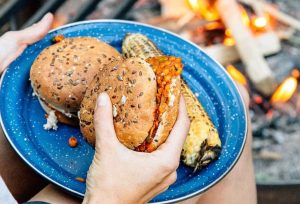
A blue enamelware camping plate. Image Credit: Fresh Off the Grid.
I used the plates often, but only because they worked well as holders for paper plates. I almost never ate directly off of them, without a paper plate liner.
The bowls and cups never felt appealing to me at all, and eventually I got rid of them.
Although I recently have spent some time looking for information about camping dishes online, I have not found anything that provides information on heavy metal levels in the glazes. In addition, brightly colored glazes often are the most problematic when it comes to the presence of various heavy metals.
I thus am thinking that maybe my instinct not to eat off of those camping dishes was a good one.
I would buy the camping plates to use as paper plate holders again though, so that I can minimize the number of dishes that I need to do on the road.
Plain white thin paper plates from the grocery store feel okay to me from a toxicity standpoint, but they are pretty flimsy to use without a good solid plate of the right size underneath them.
I have included some enamelware dinnerware sets as well as some plates on the list below, but that is because I would be interested in hearing reports about heavy metals levels if anyone tests those plates.
I am not suggesting that people with chronic illness purchase those enamelware sets to use as their usual camping dinnerware, because I am not sure whether the dishes are safe enough for that.
Another type of potentially problematic dinnerware that I tried during my camping years was melamine.
(This product is sometimes referred to as Melmac after a particular branded product available in the 1960’s.)
Melamine dishware is made from a combination of melamine (which is described as “an organic compound that has the formula C3H6N6 and that is a trimer of cyanamide”) and formaldehyde.
If this sounds toxic to you – well, no one is denying that it is toxic, and baby formula contaminated with powdered melamine sickened or killed many thousands of infants and children about a decade ago.
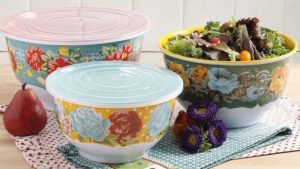
Pioneer Woman melamine bowls.
The theory with the dinnerware, however, is that the material from the dishes does not migrate into the food.
During the past few years, however, there has been some research that suggests that if hot foods are used in it, small amounts of the material might get into foods.
The current view of “science” seems to be that melamine never should be used in the microwave or otherwise heated, and probably shouldn’t be used for soups, but otherwise seems okay.
When I was camping, I had a large and colorful melamine bowl that I mostly used for salads but occasionally used to hold whole chickens or roasts to contain their juices when I was slicing them. I also had a few smaller bowl/plates in the same pattern as the big bowl that I used almost exclusively for serving salads.
My feeling about the melamine when used in that way was that it felt less toxic than pretty much all other dinnerware that I have used, including stainless steel.
Because I have grown accustomed to relying on my intuition rather than on theoretical information when it comes to avoidance, I might be willing to use melamine again in the same ways that I did before.
But I am not suggesting that anyone else use melamine dinnerware because, after all, it is objectively poisonous.
Melamine has pretty much fallen out of favor in recent years and has been replaced primarily by a breakage-resistant glass product called Corelle.
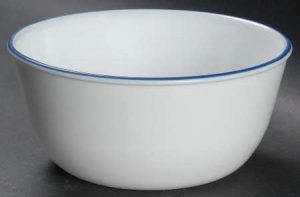
A Corelle soup/cereal bowl.
Corelle was developed by Corning Glass during the time when it was part of Dow Corning. That division of the company was more recently spun off into a housewares company currently known as Corelle Brands.
Corelle is the trademarked name for a product called Vitrelle, which is made exclusively by Corelle Brands. It is described as “a tempered glass product of two types of glass laminated into three layers.”
What substances might be present in the laminate is unclear. In descriptions of the product, company representatives state that it is made from “sand and other proprietary substances.”
Especially considering that the product was developed in association with Dow Chemical, the whole idea of Corelle dinnerware now bothers me quite a bit. How can people know what to test for to see if foods are being contaminated with toxicity from these dishes if we do not even know what substances are used to make the dishes?
However, I have used Corelle pretty frequently in the past and it feels pretty inert to me. I don’t know that I would want to cook in it, but using the bowls for hot soups or other foods has seemed okay.
With regard to heavy metals, Corelle products are reported in various places to test low in lead and cadmium, with the plain white dishes having the lowest levels.
The Corelle mugs included in dinnerware sets are made from stoneware rather than Vitrelle glass, in Asia rather than the U.S., and often feature bright colors. They therefore are more of a concern to some people than are the Corelle plates and bowls.
A fourth camping dinnerware possibility is stainless steel.
Although nothing is without risk, it may be that good stainless steel (which is made of mostly of iron with other metals – including chromium, nickel, molybdenum, titanium, copper and vanadium – added to it) possibly is the least risky of the choices listed here.
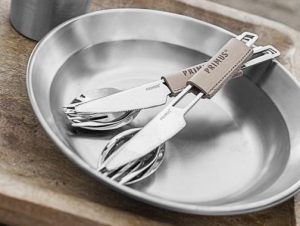
Primus Campfire Stainless Steel Bowl/Plate.
Steel comes in different grades, with the most common “food grade” ones being 18/8 and 18/10 (304) as well as 18/0 (430).
The multi-part numbers signify the amounts of chromium and nickel added to the iron, with 18/8 having about 18% chromium and 8% nickel. The numbers in parentheses are American AISI grade numbers. (Knife blades also include carbon for additional strength.)
Although the addition of nickel to stainless steel is usually considered desirable because it adds strength and beauty, some people who are concerned about toxicity prefer that the nickel be omitted and therefore opt for the nickel-free 18/0 version.
Usually, high-quality stainless steel for eating and drinking purposes will be labeled as 18/8, 18/10 or 18/0. I would be a little wary if I couldn’t find reference to these numbers or to the AISI grade number in the marketing materials.
Although I’ve frequently used stainless steel for mugs and for mixing bowls, I have not owned any stainless steel dishes. Maybe I should try some though.
Titanium is an expensive metal that is said to be non-toxic. Pure titanium is sometimes used to make dishes and cups that are prized by backpackers due to their being very lightweight but strong.
Although I would not have thought of buying titanium dishes unless going backpacking, some owners of titanium dishes report that they like their backpacking dishes so much that they use them for every meal, even when they are at home.
Recently I was in an REI store and saw a small Snow Peak titanium plate (about salad plate size) that I thought was just gorgeous. I would not mind using that small plate every day myself.
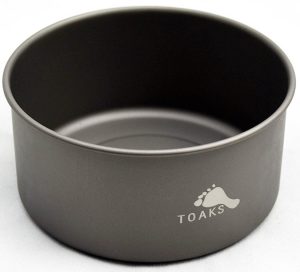
The Toaks D100mm Titanium Bowl.
With regard to camping dishes though, my usual preference is to keep things as simple and streamlined as possible.
I therefore tend to limit my dish selection to just a few items: a large dinner plate that will hold a plain thin white paper plate; a large soup/cereal type bowl; a salad bowl/plate; a large serving bowl that can be used for salads and also for roasted meats; and some medium-sized serving bowls.
For the plates, I very well might buy enamelware camping plates (one per person) since they work so well for paper plates and since a primary goal of mine when camping is to avoid washing dishes.
If I were planning to eat off the plates, I would choose stainless steel or Corelle.
Although occasionally I use paper bowls on their own, what I really would like to find is a bowl that is the right size and shape to hold a paper bowl as a liner, so that I would not have to wash the bowls after eating.
Otherwise, for soup/cereal bowls, I likely will buy either stainless steel bowls or Corelle.
A Snow Peak titanium bowl – which holds 20 ounces – also might work.
For wider bowl/plates to use for salads, I would be open to stainless steel, Corelle, titanium or melamine.
I am thinking that probably for that purpose, I will buy a couple of the Snow Peak Tableware Dishes.
Those are plate/bowls (8.2″ across) that I could put in my portable cooking kit and use for anything that I might prepare when traveling, and that also would work for salad or other dishes when I am more established at a campsite.
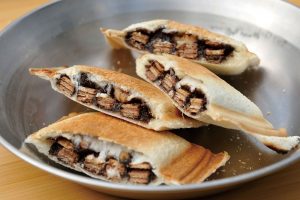
The Snow Peak 8.2″ Tableware Dish.
Besides, I really like the quality of Snow Peak products and wouldn’t mind owning a few more things from them.
The Primus Campfire Bowl/Plates also would work for this purpose, if I could find a way to purchase a couple of them without paying a lot of extra money in shipping costs.
For smaller serving bowls to use at my campsite, probably I will just use stainless steel bowls (which also will serve for other purposes such as a wash basin), but Corelle serving bowls also would work.
For a large serving bowl for salads and carving meats, although I am slightly hesitant to admit it, I probably will look for a wide and shallow melamine bowl similar to the one I used in the past.
Although I could probably find a big stainless steel one that would work if I looked hard enough, the melamine is inexpensive and light and durable and colorful, and seems to me to be as non-toxic as anything else as long as it is not used at high temperatures.
Enamelware Dishes:
GSI Outdoors Blue Camping Plate, 10″. $9.
Walmart Ozark Trail Blue Dinnerware Set, 24 Pieces. $14.
Stansport Camping Blue Tableware Set, 24 Pieces. $27.
Coleman Blue Dining Set, 12 Pieces. $29.
Coleman Camping Red Tableware Set, 25 Pieces. $33.
Melamine Dishes:
Corelle Dishes:
Corelle Soup Bowls, Set of 3. $28.
Stainless Steel Plates:
Snow Peak Tableware Plate, Large. $12.
Primus Campfire Plate/Bowl, 8″. $13.
Snow Peak Tableware Dish. $15.
GSI Outdoors Glacier Plate, 9.5″. $16.
Nicesh Dinner Plate/Bowls (Set of 6), 7.9″. $17.
Caveman Cub Plates (Set of 4), 8″. $40.
Immokaz Matte Polished Plates (Set of 2) 6.7-9″. $19-28.
Stainless Steel Dinnerware Bowls:
Snow Peak Tableware Bowl, Medium. $15.
Imeea Heavy Duty Bowls (Set of 2). $17-19.
Snow Peak Tableware Bowl, Large. $18.
GSI Outdoors 7.25″ Glacier Bowl. $25.
Caveman Cub Bowls, Set of 4. $50.
Stainless Steel Dish Sets:
HumanCentric Compact Dish Set (3 pieces). $25.
Snow Peak Tableware Set (4 Pieces). $50.
Titanium Dishes:
Toaks D190mm Plate, 7.5″. $16.
Snow Peak Trek Bowl, 5.5″. $17.
Snow Peak Trek Plate, 7.5″. $17.
Paper Bowls:
Chinet Classic White Large Bowls, 16 oz., 30 count. $7.
Vanity Fair Impressions Disposable Bowls, 20 oz., 18 count. $8.
Karat Earth B-Kind Durable Bagasse Eco-Friendly Rice Bowls, 32 oz., 50 count. $21.
Additional Information:
Amazon Discussion – Corelle and Heavy Metals
Healthy Home Economist – Stainless Steel
Nourishing Our Children – Stainless Steel Safety
Mighty Nest – Food Grade Stainless Steel
Fresh Off the Grid – Camping Food Ideas
FLATWARE
For camping purposes, my goal is to bring along flatware that is of good enough quality that I don’t mind eating with it, but not of such good quality that I would be at all upset if some of it got lost.
If I were going to buy new silverware for camping purposes, I likely would just pick a service with four place settings from Amazon or Walmart or Target, choosing a pattern that seemed to be of decent quality at a decent price.
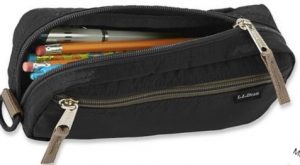
An L.L. Bean Pencil Case.
I think that ideally, I would have a set of silverware with three-piece place settings (just dinner fork, soup spoon and serrated butter knife), since the salad forks and teaspoons seem unnecessary for my streamlined camping approach.
However, I never have found a flatware set with three-piece place settings that was of decent quality and at a decent price. Just buying the extra pieces and then giving them away, if space is a particular issue, therefore seems to make more sense.
For camping with two people, a standard silverware service with four place settings worked out pretty well for me.
For some reason though, those kinds of flatware sets usually do not include serving spoons, and so I had to buy those separately.
In the RV, I had a standard silverware drawer similar to the one from home. Otherwise, I suggest purchasing a pencil case and storing flatware in it.
Although a new set of flatware can be purchased for a fairly reasonable price (such as $15-30), used flatware (even if mismatched) from other sources such as friends, family or yard sales likely would work out just fine.
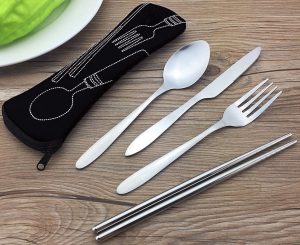
The Wayber Individual Flatware Place Setting with Chopsticks and Case.
Flatware also is one of those possessions (along with certain other kitchenware) that is most likely to be reclaimable from a mold-contaminated residence.
One thing that I would like to buy is a single set of flatware in a small case.
That way, if I stopped for a meal during my travels, I could have a clean setting of flatware right at hand, without needing to dig through my storage bins.
Although I have never used titanium flatware, many people who have bought a personal set for backpacking purposes say that they use it regularly at other times too.
Probably I would just choose stainless steel unless going backpacking, though.
Flatware Sets:
Urophylla 18/10 Stainless Steel Flatware Set, 20 Pieces. $15.
Radley & Stowe 18/0 Stainless Steel Flatware Set, 20 Pieces. $16.
Amazon Basics 18/10 Stainless Steel Flatware Set, 20 Pieces. $18.
Lianyu 18/8 Stainless Steel Flatware Set, 20 Pieces. $19.
Serving Spoons:
Update International Regency Line 18/8 Stainless Steel Serving Spoons (Set of 2). $9.
Pencil Cases:
Homecube Big Capacity Pencil Case. $13.
Stainless Steel Flatware – Individual Set:
Atc Vicbay Stainless Steel Flatware Set with Chopsticks and Case. $10.
Wayber Stainless Steel Flatware Set with Chopsticks and Case. $11.
Senhai Stainless Steel Flatware Set with Chopsticks and Case (Two Sets). $11.
Primus Campfire Stainless Steel Cutlery Set. $14.
Titanium Flatware – Individual Set:
Toaks Titanium 3-Piece Cutlery Set. $20.
Fitness City Titanium Cutlery Set with Case. $20.
Briost Titanium Cutlery Set with Chopsticks and Case. $30.
Snow Peak Titanium Silverware Set with Case. $35.
Additional Information:
The Wirecutter – Best Flatware
INSULATED FOOD CONTAINERS
One type of dishware that I have yet to try (at least since childhood) is an insulated food container.
Upon reflection though, I think that may have been a mistake and that perhaps I would benefit from using these on occasion, especially when on the road.

Filling a 17 oz. Stanley Classic Vacuum Insulated Food Jar.
For instance, I am thinking about how during the winter when I was tent camping in the Southwest, the sun would go down really early and it would get really cold.
It might have been nice to have a serving of warm food in an insulated container to eat at some point during the long night, rather than waiting hungry and cold for the sun to come up.
In addition, on days when I am traveling, it might be a nice thing to heat up a serving of food in the morning and then put it in an insulated jar, to eat later in the day.
Otherwise, I too often end up eating at random restaurants with poor food quality, eating snack-type foods, or not eating at all.
Even if I didn’t plan ahead, I still might be able to use an insulated food container to eat better on the road than I sometimes tend to do.
For instance, I could fill up the container with boiling water and dried pasta, let it sit until the pasta gets soft, drain and then add butter or some other kind of flavoring for a quick meal.
Rolled oats could be used to make oatmeal in the same way, I think. Or maybe I could even make rice congee.
Because I have been happy with my Stanley Classic Vacuum Bottle for hot drinks, I would be inclined offhand to buy the matching green Stanley Classic Vacuum Insulated Food Jar.

The Zojirushi 12 oz. Food Jar. Image Credit: Wirecutter.
On the other hand, according to the review website Wirecutter, the lid for the Zojirushi Food Stainless Steel Food Jar comes apart into four pieces and thus is much easier to clean thoroughly than the one-piece lids of some of the competitor’s food jars.
I’ve seen enough pictures recently of mold growing hidden in crevices of bottle lids that that is very appealing to me.
Zojirushi is a Japanese company and I have had good experiences with several other products from them.
This particular product also comes in several very pretty colors in addition to plain stainless steel, and it looks like it would be very functional in a variety of ways.
(For what it’s worth, I always feel a little happier when I look at the little elephant in the company’s logo too.)
All the other products listed here seem to have some potential as well though.
Insulated Food Containers:
Stanley Adventure Vacuum Insulated Food Jar, 14-24 oz. $19-23.
Thermos Stainless King Food Jar with Folding Spoon, 16 oz. $24.
Zojirushi Stainless Food Jar, 12-25 oz. $25-31.
Lunch Bots Thermal Insulated Food Container, 12 oz. $28.
Thermos Stainless King Food Jar, 24 oz. $30.
Hydro Flask Double Wall Vacuum Insulated Food Jar, 12-18 oz. $30-35.
Klean Kanteen Double Wall Vacuum Insulated Food Canister, 8-16 oz. $32-37.
Lunch Bots Wide Thermal Insulated Food Container, 16 oz. $36.
Stanley Classic Vacuum Insulated Food Jar, 17-24 oz. $35-40.
Stanley Adventure Vacuum Crock, 3 Quarts. $65.
More Information:
Wirecutter – Best Food Thermos
CUPS & MUGS
For those who are trying to avoid drinking out of plastic or silicone for toxicity reasons, and who are avoiding bringing glass or ceramic on the road to avoid breakage, there are not very many options except for metal left.
I had some lightly insulated stainless steel drinking mugs when I was on the road full-time, and I did get plenty of use out of them.
Recently I have been using the highly insulated 20 oz. tumblers offered by Yeti and Walmart Ozark Trail. Although neither is perfect, I like them enough that I have been using them at home in preference to breakable glasses and ceramic mugs.
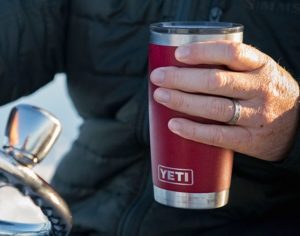
The 20-Ounce Yeti Rambler.
Rumor has it that the Yeti tumblers and the Walmart Ozark Trail tumblers are made in the same factory in China. I would believe this since the tumblers look and feel and perform virtually exactly the same, as far as I can see.
Even the lids are interchangeable in terms of their design and size.
One difference, of course, is the logo.
The Ozark Trail tumbler has a raised abstract logo that is the same color and finish as the rest of the mug, and that I don’t see at all unless I am looking for it.
The Yeti mug, on the other hand, has a large obvious logo with the word “Yeti” in metal letters toward the bottom of the mug. It is very nicely done, but I would prefer not to have logos on my possessions at all, regardless of how trendy the brand is.
Both of the products keep drinks hot or icy cold for a long time, such as for 24 hours or more. They both seem very well made and come in a variety of pretty colors.
Both mugs have plastic lids that are stated as being BPA-free. I’m not very reassured by this though, because my understanding is that plastics without BPA likely cause similar health effects.
While it is possible to remove the lid and then drink with my lips touching stainless steel, that is a lot of trouble to do every time I want to take a sip of the drink. The plastic does not feel bad to me, and so theoretical concerns aside, I have been drinking using the lid.
If I were more concerned about the plastic, then I likely would opt for simpler and shorter metal cups or mugs without lids (or would not use their lids) when camping.
The main functional difference between the Yeti tumbler and the Walmart Ozark Trail tumbler that I can see is with the exact design of the plastic lids.
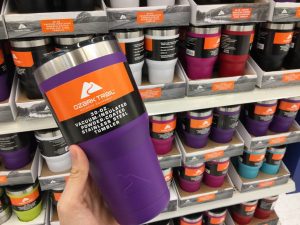
A Walmart Ozark Trail 30-Ounce Tumbler.
The Ozark Trail version has a small hole in the top of the lid, to allow the liquid to be sipped when the mug is tilted.
Some Yeti drinkware has this kind of lid too, but the 20 oz. tumbler that I bought currently comes standard with a sliding lid.
(Although a Coolers on Sale video suggested that the Ozark Trail tumbler that they were testing had an issue with the gasket on the lid, I have not had any problems like that with the one that I have purchased. I do suggest taking a look at some different lids in the store and picking the one that seems to function the best though.)
Yeti sells its slider lids – which are said to include magnets – for $10 each. Walmart sells Ozark Trail slider lids (currently in stores only) for around $3 each.
I tried an Ozark Trail slider lid, and it’s true that the slider on it did not stay in place as well as the Yeti version with the magnet does.
However, since the sliding Yeti lid still is not secure enough that it will allow me to place the mug in a backpack or other bag without worrying about it leaking, I’m not quite sure what the actual functional benefits of the lid ever will be for me.
Apart from the lids and the logo (and the color selection), the only apparent difference between the tumblers is that the Yeti tumblers are more than three times the cost of the Ozark Trail tumblers.
For instance, the Yeti tumblers are $30 for the 20 ounce and $35 for the 30 ounce.
The Ozark Trail tumblers are currently less than $7 for the 20 ounce and $7-9 for the 30 ounce.
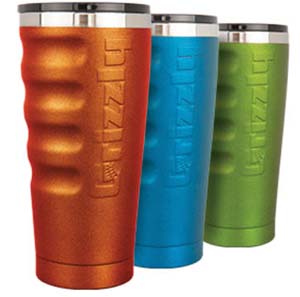
Some 20-Ounce Grizzly Grip Cups.
I would have an extremely hard time bringing myself to buy more than one mug costing $30 (and even one was a real stretch for me).
At $7 each though, I feel like I can afford to have all my camping drinkware be these Ozark Trail mugs.
Probably when I go camping, I will take along four Ozark Trail tumblers (two each for myself and a guest).
I also want to try out an Ozark Trail water bottle for hiking.
For those who decide to purchase a Yeti tumbler, I would strongly suggest buying it directly from the company or from an authorized retailer since reports suggest that the vast majority of the ones sold on Amazon or other such retailers are fakes.
Another highly insulated mug that I would like to try out if I can find a store that sells it is the Grizzly Grip Cup, which has indentations on the side of the cup that supposedly allow it to be held more easily.
I like the color selection and the looks of those cups, and the pricing is more on the moderate side ($15-20) than with the Yeti ones.
Like all of the highly insulated mugs that I have come across though, the Grizzly cups are made in China.
I’m also interested in a Zojirushi mug, which looks like it could be carried in a backpack or tote bag without leaking.
However, some of the reviews on Amazon suggest that Zojirushi mugs being sold on that site may be fakes, and so I would have to figure out the right place to buy one of these mugs if I were going to spend that much money on it.
Stainless Steel Drinking Cups:
Stansport Stainless Steel Mug, 17 oz. $8.
Klean Kanteen Single Wall Stainless Steel Cups, 10-20 oz. $10-13.
GSI Glacier Stainless Cup, 14 oz. $12.
Clean Steel Stainless Steel Cups (Set of 2), 16 oz, $14.
Greens Steel Premium Metal Drinking Glasses (Set of 4), 16 oz. $20.
Greens Steel Endangered Animals Edition Stainless Steel Cups (Set of 4), 10 oz. $26.
Caveman Insulated Stainless Steel Pint Cups (Set of 4), 16 oz. $35.
Stainless Steel Insulated Mugs:
Trudeau Boardroom II Mugs, 16 oz. $18.
Tru Blue Steel Insulated Stainless Steel Mug (Set of 2), 14 oz. $19.
Better for Your Stainless Steel Mugs (Set of 2), 13.5 oz. $20.
Heavily Insulated Mugs & Cups:
Additional Information:
Coolers on Sale – Ultimate Tumbler Challenge
Affiliate Links
This article includes affiliate links for the Amazon, Walmart and Yeti sites. If purchases are made subsequent to individuals clicking on these links, then I may get a small percentage of the sales price (between 2-8% of the total amount).
I made a special effort to become a Yeti affiliate because reports suggest that such a high percentage of Yeti products sold on Amazon are counterfeit that I did not want to link Yeti pages on there.