
The Living Clean Guide to Avoiding Glyphosate (And Other Bad Stuff) in Foods – Sauces & Seasonings


Red Boat Fish Sauce.

Mayonnaise
Mayonnaise is very easy to make at home and will keep for a week or so in the refrigerator. A big benefit of homemade mayonnaise is that you can use any type of oil you like (I think olive oil is good but some people prefer avocado. sunflower or other oil).
Homemade mayonnaise can be made with an immersion blender or a regular blender (a food processor will work fine too). If you are nervous about raw egg yolks, you can cook them first to be safe.
However, there are many situations (such as camping) where making your own mayonnaise may be totally impractical. And personally, although I usually make mayonnaise if it is an important part of a recipe, I do also have a jar of store-bought mayo in the refrigerator to use in smaller amounts on luncheon meat sandwiches or emergency tuna fish salads.
Most of the organic mayonnaise on the market – including Spectrum, The Ojai Cook and Woodstock – contains eggs plus soy oil, which holds up well in mayonnaise but supposedly has the potential of contributing to thyroid issues and other health problems. I have sometimes purchased these products but tended not to eat too much of them, in large part due to these kinds of health concerns.
Another product line that I have used on occasion is Vegenaise. This company’s products are sold in the refrigerator section of the grocery store, do not contain eggs and are stated as being GMO-free across the board. There are several varieties, which contain the following main ingredients.
Organic: Soybean oil, soy protein.
Regular: Canola oil, soy protein.
Grapeseed: Grapeseed oil, soy protein.
Soy-Free: Safflower oil, pea protein.
I have purchased this product mostly with the goal of avoiding soy oil and canola oil, and so have only tried the grapeseed and the soy-free versions.
Recently I tried two newer mayonnaise products, both of which are soy-free.
Primal Kitchen is a mayonnaise product created to serve the Paleo community. It contains eggs and avocado oil (and no sugar at all). All the ingredients except for the avocado oil are organic.
Sir Kensington’s Organic contains egg yolks and sunflower oil. (The Sir Kensngton’s line also includes some other mayonnaise items, including an avocado oil version that is non-GMO but with only the sugar marked as organic.)
In tasting all of these mayonnaises, my conclusion is that none of them taste as good as my homemade mayonnaise right off the spoon, but that they are all at least acceptable when used on food.
The non-vegan mayos with soy oil taste the most like Hellman’s, if that is a goal. Of these, I think The Ojai Cook version is the best.
The Vegenaise does not really taste like mayonnaise to me, but it does taste fresh and mildly pleasant. Mostly it adds the desired creaminess to foods in an innocuous way.
The Sir Kensington’s tastes to me very slightly like Miracle Whip (and not in a bad way at all) – slightly more sugar and a bit more mustard and other spices than the rest of the brands discussed here.
The Primal Kitchen mayonnaise seemed a little less good to me off the spoon than the others in terms of the taste. Still, I’ve managed to get through most of a jar of it and it has been fine.
Although I tend to think that concern about soy has been blown a bit out of proportion, probably I will try to steer away from the soy-oil mayonnaise in the future since the non-soy products also seem fine. I’m sort of thinking I may stick with the Sir Kensington’s, but I will see how I feel about it in different foods as I use up the jar. The soy-free Vegenaise likely would be my second choice at this point.
A mayonnaise that I have yet to try is Wilderness Family Naturals, which is both soy-free and organic. It uses sesame seed oil, coconut oil, olive oil, sunflower seed lecithin and eggs, and it tends to get great reviews from customers. However, it is available only sporadically and to my knowledge only from the company’s website.
I also not yet tried the flavored Primal Kitchen Chipotle Mayonnaise, which gets particularly good reviews. It contains pretty much all organic ingredients except for the avocado oil.
Sir Kensington’s Organic Mayonnaise
Sir Kensington’s Special Sauce (2)

Salad Dressing
Except for the period of time when I was trying to find convenient food products to sell to Mercey Hot Springs’ guests, I have pretty rarely purchased bottled salad dressings. I find it much tastier to make my own dressings, which I usually do in about two minutes by mixing olive oil and vinegar (with a little bit of mustard, herbs and sweetener added) in a cup.
Sometimes I mix mayonnaise (homemade or bottled) and/or sour cream with flavoring agents – such anchovy paste, garlic, herbs, or honey and mustard – plus a little water, to create a creamy dressing.
Once in a while, I make up a batch of tahini dressing in the Vitamix or food processor. Japanese-style carrot-ginger dressing is also very good.
The only pre-made dressings that I have ever been very enthusiastic about are from Cid’s Food Market in Taos, NM. That local food store (which is great in a wide variety of ways) offers a line of really terrific, freshly made, mostly organic, refrigerated bottled dressings, including fermented blue cheese and ranch versions that will bubble all over the place if they are mistakenly left outside the refrigerator. I still miss those dressings and wish I could figure out how to make them.
Bottled shelf-stable dressings can be convenient for certain occasions such as eating out or camping however.
My favorite such dressings are made by Big Paw, a tiny company located in Hollister, CA.
Big Paw uses high-quality organic or pesticide-free California produce to make outstanding flavored balsamic vinegars and extra-virgin olive oils. They then mix these together (along with a few spices) to create what they call “bread dippers” – that is, unusually high-quality salad dressings. (My favorite bread dipper, the Spaghetti Western, also includes gorgonzola cheese, pickled garlic and brown sugar.)
Almost all of Big Paw’s many products (vinegars, olive oils and bread dippers) are currently priced at about $15 per bottle, and they will provide free shipping with the purchase of any four bottles. The flavored vinegars are different than any that I have seen elsewhere (and very good), and so it may be worth placing an order just to try those out.
Another good-quality line of dressings is made by Bragg Live Foods. Most of their dressings incorporate their own core products of apple cider vinegar, extra-virgin olive oil, “liquid aminos” (unfermented soy sauce), and herbs. They also make a fat-free, sugar-free, fruit-based dressing called Braggberry that many people rave about.
Recently I tried Primal Kitchen Honey Mustard Vinaigrette, which is a shelf-stable dressing containing non-organic avocado oil and a variety of other natural ingredients. Although I have yet to try the other dressings from the company – Greek Vinaigrette and Ranch – I thought that this one was quite good.
Although I don’t feel that I can exactly recommend Annie’s dressings due to the low-quality oils they use, they are widely distributed and their organic products are still much better than most options out there. Some flavors are much tastier than others though, with the Goddess (Tahini) and Shitake/Sesame versions usually getting the top marks.
Stonewall Kitchen has two brand-new, yummy-sounding organic dressings (Honey Orange Balsamic and Miso Ginger) that I would like to try. (Since the company claims that their whole product line is virtually free of GMO’s, some of their regular dressings may be worth considering as well.)
Tessemae’s (a broad line of bottled, organic food products that I have yet to try but that is popular among those following the Whole30 diet) makes several salad dressings with higher-quality ingredients.
I also am interested in trying the dressing lines from Wilderness Family Naturals and from Organic Girl.
Primal Kitchen Honey Mustard Vinaigrette (2)

Vinegar
Although balsamic vinegar (like wine) has the potential of being contaminated with mycotoxins, Big Paw’s products feel clean to me and are available in many delicious flavors. I have really enjoyed the Mission Fig, Apricot Lavender and Blackberry Vanilla, for instance. Free shipping is currently available from the company with the purchase of any four bottles of the company’s products.
Bionaturae (an Italian company) also makes excellent classic balsamic vinegar that I have purchased many times.
A number of good flavored vinegars are produced by Wind Ridge, an organic herb farm in Illinois.
For apple cider vinegar, I always buy the raw version made by Bragg and have been happy with it.
Eden makes raw apple cider vinegar that I would guess is good, although I have not tried it yet.
Eden and Marukan sell good rice-wine vinegars.
Eden also imports from Japan a terrific Ume Plum Vinegar, which is salty and flavorful with the taste of umeboshi plums and that so far I have mostly used to flavor homemade kale chips or sauteed kale. It is not marked as organic but all of Eden’s products are stated as being GMO-free.
Fermented Sauces
The fermented sauce that I have used most often is San-J Organic Tamari, which is widely available and reasonably priced. Since the ingredient list does not specify a particular kind of salt, I use the low-sodium version and then add additional good salt if the dish needs it.
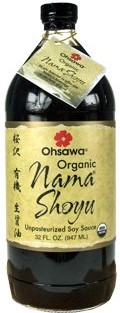
Recently, though, I did a side-by-side comparison tasting and was blown away by how much better the Ohsawa Nama Shoyu was than the San-J, in terms of both smoothness and depth of flavor. Since then, my Chinese cooking has taken a great leap forward just by switching to that sauce (and I am not planning to go back). Although nama shoyu contains wheat, I wonder if the fermenting might break down the gluten and fructans enough so that they are not a problem for many sensitized people.
Another soy sauce product that I enjoy is Eden Ponzu sauce, which is made in Japan. It contains soy sauce, rice vinegar, mirin, barley malt, and two kinds of tart citrus juices, and it is very flavorful. Although it is not marked organic, all of Eden’s products are GMO-free and it feels fine to me.
Although I do not believe that it is important for most people to avoid fermented soy since the fermentation process breaks down the problematic substances in the soy, Coconut Secret Coconut Aminos are a pleasant-tasting alternative that add some umami to foods. I find them too sweet and too lacking in character to be very interested in using them though.
Red Boat Fish Sauce has become popular in large part due to promotion by the very good food blog Nom Nom Paleo and others in the Paleo community (much of which does not approve of any soy). Although I would not go so far as to put it on almost everything as they suggest they are doing, I do enjoy it on occasion.
Mirin is a sweet fermented Japanese rice wine that I add to many Asian dishes for more depth of flavor. Good mirin is expensive, but it makes such a difference that I often use it anyway and usually choose the Eden brand. Sometimes I will substitute just plain rice wine plus a little sugar though.
A product that I used to be very fond of is Lea & Perrins Worcestershire sauce, but the organic versions (sold by Annie’s and The Wizard) are made from totally different ingredients (including soy sauce with wheat in it) and do not taste the same at all. It helps to add a little Red Boat fish sauce to them, but there still is something seriously lacking.
The Lea & Perrins distributed in the U.S. is made in Canada and has a totally different ingredient list than the UK one (for a while they were even putting corn syrup in it). It also tasted really toxic to me when I tried it, perhaps because of glyphosate-contaminated sugar.
I thought the UK version – which I ordered through Amazon for slightly more than $10 – was a lot better. It is pretty much exactly what I remember it being when I was growing up in 1970’s, and it doesn’t seem toxic to me at all. That is a little perplexing though, since the first ingredient on the label is malt vinegar and it is my understanding that barley in the UK is often sprayed with glyphosate as a pre-harvest dessicant. (The other ingredients are spirit vinegar, molasses, sugar, salt, anchovies, tamarind extract, onions, garlic, spice and flavourings.) Nevertheless, I’m going to be sticking with this Worcestershire sauce for the time being and am happy to have found it.
Fermented sauces in general tend to contain a good bit of natural glutamate and histamine. I use them only occasionally, but some some people need to avoid them entirely.
It is perhaps worth noting here that Bragg liquid aminos – while popular – are processed with chemicals rather than fermented. It’s been quite a while since I have used them, partly for theoretical concerns but mostly because I just like other products much better anyway.
Miso
Miso is another fermented product that I have found to be delicious and healing.
I use it a lot more often now that I have realized that just stirring a spoonful into moderately hot water makes a tasty soup that is far, far better than any of the boxed miso soups that I once spent a lot of time sampling.
(If I want to be fancy, I will add a little soy sauce and a little sesame oil, and maybe even a little bit of sliced green onion, to the cup.)
Miso Master is a reliable brand.
Recommended:

Grilling Sauces
Barbecue sauce is an especially difficult category, since almost all bottled sauces contain glyphosate-contaminated sugar, food additives and other undesirable items. While making your own barbecue sauce using a combination of bottled ingredients is not too difficult, bottled sauce is much more convenient and also can be fun.
One sauce that I have really enjoyed is SFQ, a “San Francisco-style” barbecue sauce that I first learned about from the Bi-Rite store in SF. It is based on organic ketchup with added ingredients, including coffee, chocolate, wine vinegar and a variety of international spices, in addition to the more standard molasses, brown sugar and hoisin sauce and hot pepper. Although not all the ingredients are noted as organic (I have particular concerns about the soy and corn in the hoisin sauce), this product seems pretty clean to me and the subtle flavor combination (somewhere between a barbecue sauce and a mole sauce but with even more complexity) is really terrific. For those who are interested in trying it but do not live in the Bay Area, the Flavored Sauce Shop offers single jars of the sauce with a comparatively low shipping cost.
While I have not been very impressed by the American-style barbecue sauces from the big organic companies, Organicville produces some barbecue sauces – as well as some teriyaki sauces – that are not too bad. I just wish they would switch to a better sweetener than agave.
Organicville also recently launched a line of a wide variety of Asian and Hispanic sauces under the Sky Valley brand name. All of the sauces are gluten-free as well as either organic or GMO-free (with hot peppers being pretty much the only non-organic ingredient), and I am not see that any agave is being used. I tried the all-organic Korean BBQ Sauce and liked it quite a bit, and they have several other sauces that would be appropriate for grilling as well.
I’m also happy to see that Stonewall Kitchen has just released two new organic barbecue sauces – Honey Miso Barbecue and Smokey Maple Barbecue – as well as an organic and gluten-free Sesame Teriyaki Sauce. I am really looking forward to trying those!
Montana Mex makes two spicy organic grilling sauces – Sweet & Spicy BBQ and Sweet & Spicy Habanero – that I just noted as being available through Vitacost that I have yet to try.
There also are a few very small producers of organic barbecue sauce – Bill’s Best, Kinder’s and Triple Crown – out there that I have not tried.
Organicville Barbecue & Teriyaki Sauces
Sky Valley International Sauces
Salsa
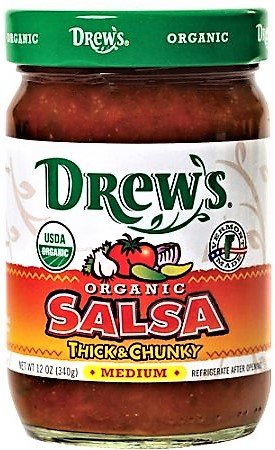
We sampled a great many organic salsa sauces when I was at Mercey Hot Springs, and the line that I thought was the best of the ones that we tried was Drew’s.
The salsas from Amy’s and Organicville were also pretty good.
Green Mountain Gringo makes a high-quality and reliably tasty salsa that I am glad to see is now labeled as GMO-free.
I’ve not yet tried the heirloom tomato salsas offered by Happy Girl Kitchen, but based on the quality of their other tomato products, I am sure that the salsas are outstanding too. They are pretty pricey at $10 per 16 ounces though, plus there is a shipping charge for mail-order.
Some newer organic salsas that I would like to try are Enrico’s and Naked Infusions.
Green Mountain Gringo Salsa (2)
Late July Salsa

Hot Sauce
The only two wholly organic lines of standard hot sauce that I have been able to find are O’Brother, That’s Hot! and Arizona Pepper Organic Harvest. Each offers pretty good-quality products in the three most popular styles (jalapeno, habanero and chipotle).
The Wizard also makes an organic, mildly hot concoction called Hot Stuff that is tastily flavored with umeboshi plums. (Although I am not entirely happy about the presence of agave in it, the amount seems too small to worry much about.)
I think that certain mainstream hot sauces can be good choices as well, provided that they do not use extraneous chemicals or other problematic additives that do not belong in hot sauce anyway. Some suggested choices that I have tried are The Pepper Plant (for mildly hot, flavorful sauces); Melinda’s (for wholly natural, moderately hot to very hot sauces); Dave’s Gourmet (for mildly hot to insanely hot sauces); and plain old Tabasco (for the classic hot sauce that everyone knows what to do with).
(I would stick with the Original, Chunky Garlic and Habanero sauces for The Pepper Plant though, since it is unclear what kind of sugar they are using in their other products.)
Organicville offers a number of hot sauces as part of its new Sky Valley line of international sauces. All of the sauces are gluten-free as well as either organic or GMO-free (with the hot peppers being pretty much the only non-organic ingredient). I tried the Sriracha Sauce and thought it was quite good. Based on the ingredients lists and my first few experiences with this line, I am feeling really optimistic about it.
Amore (an Italian company) makes a non-organic chili pepper paste that can be squeezed out little by little as needed from a tube. I have not tried this Amore product yet, but I like their other pastes so much that I suspect this one is very good too.
Arizona Pepper Organic Harvest Hot Sauce
O’Brother, That’s Hot! Hot Sauce
Sky Valley International Sauces (2)
The Pepper Plant Hot Sauce (2)

Ketchup
I’ve never in my life been a ketchup fan and always was mystified at why so many people liked it so much.
That totally changed recently when I tried Stonewall Kitchen Country Ketchup, though. It was a revelation – thick with big chunks of vegetables, spooned out of a wide-mouthed jar, with a really great balance of flavors. It was good enough that I found myself thinking about cooking particular meals with the express goal of being able to use that ketchup on them.
I then tried the company’s Truffle Ketchup, which is a totally different style and contains what seems to be substantial amount of white truffle oil. It was, if anything, even better than the Country ketchup.
Stonewall Kitchen has long seemed to me an odd company, with a sophisticated target market and a history of being associated with farmers’ markets but a stubborn disinclination to focus at all on toxicity issues. When I tried to query them on the topic four years ago, they acknowledged that they used only cane sugar but otherwise refused to answer any of my questions at all.
I’ve continued to have a slightly guilty affection for their products and to purchase their jarred products from time to time though. Even though I always wonder about the toxicity issues (and even though they are on the expensive side for a non-organic brand), they always taste good enough that I never have been sorry when I have bought them.
Now, finally, Stonewall Kitchen is reluctantly committing to having all their products verified as GMO-free (they say very few of them had GMO’s to begin with) and have just introduced more than a dozen or so organic products (including some preserves, some grill sauces, some salad dressings, a relish and some baking mixes). Because I am so fond of this company from a taste point of view, I am really excited about this development and am looking forward to trying all these new products.
In the ketchup category, the company currently makes four different non-organic spoonable products (a smooth traditional Farmhouse Ketchup and a Chipotle Ketchup, in addition to the Country and Truffle versions that I have tried).
They also make a similar Cocktail Sauce that I also have liked a lot (though it’s much better with some fresh lemon juice and some bottled horseradish added to it).
Over the years I’ve tried a bunch of brands of organic ketchup – including Annie’s, Woodstock, Organicville and Heinz Organic – and while nothing was really wrong with any of them, I don’t feel like I can really recommend them since I never eat them myself except when doing taste testing.
(A couple more organic specialty ketchups that I have yet to try: Elevation and Montana Mex.)
Recently I compared Sir Kensington’s Classic Ketchup (a non-organic, non-GMO product that is more expensive than the Stonewall Kitchen ketchup on a per-ounce basis) to Annie’s ketchup and to the Stonewall Kitchen Country and Truffle ketchups. The Sir Kensington’s was slightly more heavily spiced than the Annie’s, but otherwise they seemed exactly the same.
The Stonewall Kitchen ketchups were in a totally different class though. And that makes me wonder if there are other particularly good Stonewall Kitchens items that I’ve also been missing out on, due to my (apparently largely unwarranted) fears about ingredient toxicity.
Stonewall Kitchen Ketchups (2)
Stonewall Kitchen Cocktail Sauce (2)

Mustard
First, for those who are real mustard fans (or feel that they could become fans if they obtained the right product), it may be worthwhile to just go ahead and order a jar of the heavily seeded and sharply flavored Pommery Moutard de Meaux from France and be done with it. There is nothing that approaches it in the U.S., and its not being labeled as organic does not seem to me to be an issue of concern. (Just be patient in prying the plastic top off the jar – a butter knife or something similar will be needed.)
Note that despite having a lot of seeds in it, the Old Style mustard sold by Maille is now made in North America and that I am pretty horrified about the sugar, dextrose and natural flavors listed on the label. (Those sound like they are likely contaminated with glyphosate and would make for a terrible seeded mustard regardless.)
More authentic seeded mustards from France occasionally have been spotted at Costco or Trader Joe’s, however, and so could be worth keeping an eye out for.
The closest organic mustard that I have found to the Pommery is Eden, but it has not enough mustard flavor and too much apple cider vinegar for my taste, and in general really isn’t the same at all.
I also used to really like the mild and creamy flavored organic mustards from True Natural Taste, but they are not currently being made. Annie’s is the closest available organic substitute.
I’ve tried a few of the creatively flavored mustards from Stonewall Kitchen (a company that states on its website that it has removed virtually all GMO ingredients from its line). Despite the company’s unfortunate tendency to use thickeners such as cornstarch and xanthan gum in many of its mustards, they are not too bad for that kind of thing.
A few other mustard lines with ingredients that sound good despite not being labeled as organic that I would like to try are Sir Kensington’s and Mustard & Co.
Looking around locally for mustard (or even making it yourself through a fermentation process) also may be worthwhile.
For instance, recently I picked up a spicy German-style mustard (non-organic but with simple non-objectionable ingredients) from the Amana Meat Shop and Smokehouse here in the Heartland. It certainly was a lot better than anything that the big organic companies are selling anyway.

Additional Sauces
Many condiments for adding flavor and texture to foods (including grilling sauces, hot sauces, ketchup, mustard, mayonnaise and fermented sauces) are discussed in their own categories in this article. This sections includes stir-fry sauces as well as a hodgepodge of other bottled condiments not discussed elsewhere.
The Ginger People Sweet Ginger Chili Sauce is a very nice product that works well on any kind of fried foods or in stir fries. It is non-organic/non-GMO (and does not include any other non-organic ingredients that especially concern me in terms of likely glyphosate contamination). I suspect I will be buying this sauce again now that I have discovered it.
I’ve enjoyed a few items from the new Sky Valley line of sauces from Organic Valley and would be interested in trying more. In addition to the barbecue sauces and hot sauces discussed in other sections, certified organic items from this line include a General Tso’s Sauce; a Teriyaki Sauce; a Plum Sauce; a Thai Peanut Sauce and a Miso Glaze & Marinade.
Some additional Sky Valley sauces are non-organic/non-GMO and free of items (such as wheat, oats or barley) that I consider to be high risks for glyphosate contamination. These include a Sweet Chili Sauce; a Mole Sauce; a tomatillo-based Verde Sauce; an Enchilada Sauce; and a rice-wine Koji Sauce.
San-J also offers a line of non-organic/non-GMO Asian sauces (made in the U.S. rather than Japan) that are free of ingredients that I consider to be at high risk for glyphosate contamination. I tried their Sweet & Tangy Cooking Sauce (which gets most of its sweetness from honey, pineapple juice and apple juice) and thought that it was pretty good. I might be inclined to experiment more with this line, especially since it is pretty reasonably priced.
Sky Valley International Sauces
The Ginger People Sweet Ginger Chili Sauce (2)
Flavoring Juices & Pastes
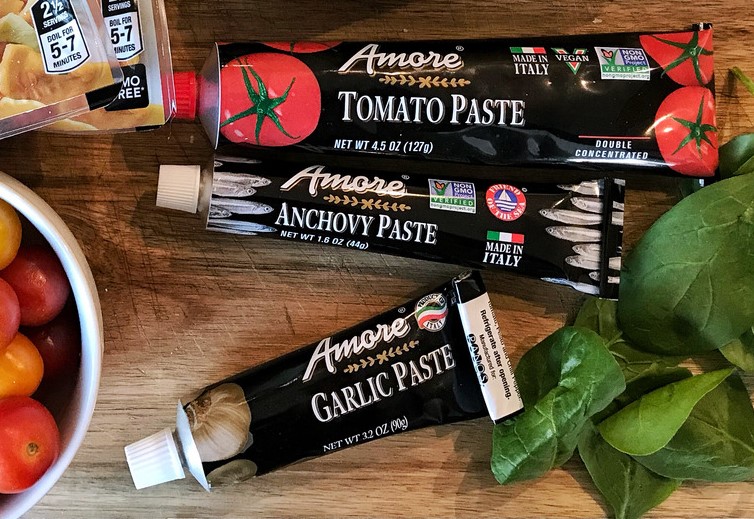
The Amore pastes (tomato, garlic, pesto, herbs, hot peppers or anchovy) are labeled as GMO-free but not organic. They are from Italy, seem to be very high-quality, and are convenient since just a little bit can be squeezed out of the tube as needed. I feel really good about that product line, and the fact that the products are inexpensive is a nice bonus.
Eden Umeboshi Plum Paste is a fermented plum product from Japan that adds an intriguing tart and salty flavor to a variety of foods. (Those who find themselves drawn to it also may be interested in the Eden Ume Plum Concentrate, which provides the same digestive benefits and flavor – but without all the salt – in tea form.)
I use quite a bit of grated horseradish and seem to have done fine with the random brands that I have found on refrigerated store shelves. I do buy the Bubbies product when I can find it though.
I usually make my own fresh ginger juice since I have the juicer set up, but the The Ginger People organic bottled product is a nice option.
The Ginger People Ginger Juice

Herbs and Spices
A big problem with dried herbs and spices is that even if they are organic, they have the potential of becoming moldy. Choosing a quality supplier therefore can be very important.
My current approach to spices is to buy just a few of them in one-pound bags from Frontier and then to use them liberally. The quality is really good and they are much less expensive that way.
Frontier’s organic spices often are available for purchase in smaller amounts from the bulk section in larger natural food stores as well.
I really like Savory Spice’s stores and feel that all of the products that I have purchased from them (organic or not) have been very high-quality and clean. It has been quite a few years since I have had a chance to visit The Spice House, but my experience was that their products were excellent as well. I am happy to see that both of these companies have increased their selection of organic spices during the past few years.
A remarkable product that I discovered at the Taos Farmers’ Market is the dried Oregano de la Sienna grown and sold by a local farmer named Todd Bates. It has an amazing fragrance and the kind of flavor that is well-suited to sprinkling into a wide variety of dishes (it’s especially good with potatoes and with Mexican food). Bates sells large boxes of the dried flowers (a beautiful purple color), the leaves (not as dramatically pretty but just as fragrant), or a mixture. (If you don’t think you can use up the whole box – you might be surprised – consider putting some of it in nice jars and giving it away as gifts.) Although there is not yet a website for the company, orders can be placed via email at nmnpr68@yahoo.com.
I have never had a noticeable problem with good vanilla extract, but the dried vanilla powder from Bulletproof is a fine alternative to it.
Mold in black pepper is such a problem that Dave Asprey advises avoiding it entirely. I personally think that is going too far and that a better approach is to put some effort into finding pepper that is not moldy.
My own feeling about how to go about this is based on my belief that people actually know instinctively whether food that they are eating is poisoning them, and therefore that if just about everyone is absolutely crazy about a particular black pepper product, likely that means that it does not contain significant amounts of toxic mold. I thus looked on Amazon for the whole black peppercorns that people seemed to like the most – which turned out to be this Spicy World brand, with more than 1200 reviews and an average of five stars.
So I took a chance on spending the $13 for a big bag and they turned out to be terrific. I’m using far more pepper than ever before and am feeling really good about it.
For salt, I have had good experiences with grey French sea salt and Himalayan pink sea salt (and am not very worried that the latter will give me lead poisoning).
Usually, however, I use Redmond Real Salt, which is a a salt mined in Utah from ancient sea beds. I think it is at least as tasty and clean-feeling as the other kinds of salt that I have tried, and it also is more widely available and economical.
Spicy World Tellicherry Peppercorns (2)
Seasoning Blends
Although I think it is a good thing for spices to be organic, it’s my feeling that an even bigger toxic threat than the sorts of pesticides used on on spices is mycotoxin contamination.
Mainstream brands of spices – including organic brands – often become ridiculously moldy and thus full of mycotoxins. Seeking out quality products where care has been taken to guard against spoilage of ingredients during the production process is really important, therefore.
A few basic multi-purpose organic seasonings that have felt consistently okay to me are the various spice mixtures made by Redmond and Bragg.
Wind Ridge – an all-organic herb farm located near Rockford, IL – sells a variety of herbal blends for salad dressings and seasoning.
I have in recent years purchased a variety of really good-quality spice and tasty blends from the Denver-based chain store and mail-order company Savory Spice.
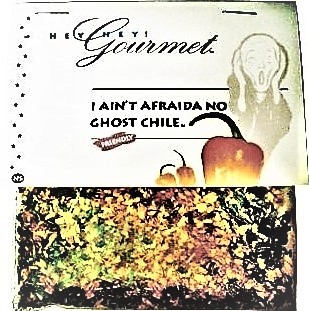
Hey Hey Gourmet (a tiny northern California company) also makes really good spice blends with many homegrown or certified organic ingredients. Their products are available by mail order with reasonable shipping costs.
Eden’s line of Japanese table seasonings – including their sesame seed and seaweed based sprinkling products – also seem to be consistently good.
Although it’s been a number of years since I have dealt with them, I also have had good experiences with the spice blends offered by The Spice House.
Hey Hey Gourmet Spice Mixes (2)
Savory Spice Blended Seasonings (2)
The Spice House Spice Blends (2)
Links on this page are in orange (no underlining).